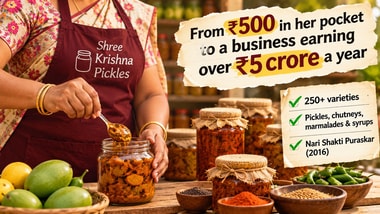
Krishna Yadav moved to with her husband and three children, carrying just ₹500. After struggling to find work, she began selling on the roadside. Her venture eventually grew into a brand offering more than 250 varieties of pickles, chutneys, marmalades and syrups.
Building a business does not necessarily require substantial initial capital. Krishna Yadav’s entrepreneurial journey illustrates how a small beginning, technical training and an understanding of customers can help turn a roadside venture into an established food business, Economic Times reported.
Yadav, who moved to Delhi from a village in , started selling pickles on the roadside before establishing Shri Krishna Pickles. The business has since expanded its product range to more than 250 varieties and reportedly earns over ₹5 crore annually.
Born in Daulatpur, a small village in Uttar Pradesh, Yadav did not have the opportunity to receive formal education. After marriage, she moved to Bulandshahr. However, the family’s financial circumstances deteriorated after her husband, who worked as a traffic police officer, lost his job.
The family faced further setbacks when her husband’s business ventures failed, forcing them to sell their homes and struggle to meet basic expenses, Economic Times reported.
“He tried to start a vehicle trading business, but we incurred huge losses. We had to sell our two houses, each spread across 150 gaj (approximately 1,300 sq ft). It became increasingly difficult for us to survive. We couldn’t afford to eat vegetables anymore and survived on namak roti,” she recalled.
Looking for a fresh start, Yadav moved to Delhi and began living at her father’s house. She arrived with her husband and their three young children, carrying just ₹500.
The couple initially struggled to find employment. Yadav’s lack of formal education made securing a job difficult, while her husband also faced challenges in finding work. After two months of unsuccessful attempts, they turned to sharecropping and began farming.
A turning point came when Yadav watched a television programme about a training initiative aimed at reducing post-harvest losses through value addition. She subsequently enrolled in a course at Krishi Vigyan Kendra (KVK), where she learnt how to prepare pickles and murabba.
Although she had grown up watching her mother make pickles, the training helped her understand how to improve their taste and extend their shelf life.
In 2002, the family began selling pickles along busy roadsides. Their initial marketing strategy was simple: set up a small stall, offer free drinking water and introduce passers-by to their products through samples.
“We set up a small table on the roadside and put our products on display. It was not a very busy road but we wanted to attract people to our stall. So, we placed two large earthen pots of water along with the pickles. I offered pickles as samples to those who stopped to drink free water,” she said.
The approach helped Yadav build an initial customer base. She also took her products to local fairs to reach more buyers.
She initially sold karonda (black currant) pickle before expanding the range to include mango, chilli and lemon varieties. The venture eventually developed into Shree Krishna Pickles.
The business has expanded considerably since its roadside beginnings. Today, the brand offers more than 250 varieties of pickles, chutneys, marmalades and syrups. It reportedly earns over ₹5 crore annually.
Yadav has also received recognition for her entrepreneurial journey and contribution to business. She was awarded the Nari Shakti Puraskar in 2016 and the NG Ranga Award in 2014, among other honours.
Her journey traces the growth of a small food venture that began with limited resources and a roadside sales strategy into a business with a wide product portfolio.