


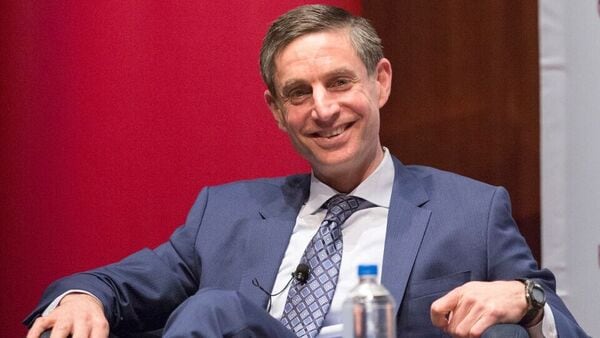
New Delhi: India’s growth and prosperity can bode well for the world, American economist Michael Greenstone said, in a sharp contrast to the view that a stronger Brics grouping would be a threat to the US.
In response to a question on how he perceives the rise of the Brics grouping, Greenstone, former chief economist in the Obama administration, said: “I don’t have the view that the world is zero sum. I think a strong and prosperous India can be very good for the world and the same with the other members of the countries.”
Greenstone spoke in an interview with Mint on the sidelines of the Kautilya Economic Conclave in New Delhi.
Brics, initially comprising Brazil, Russia, India, China and South Africa, expanded in 2024 to include Egypt, Ethiopia, Iran, the United Arab Emirates and Saudi Arabia, with Indonesia joining in 2025. India last month hosted the Brics leaders’ summit.
The 11-member group accounts for a half of the world’s population, about 40% of its gross domestic product and almost a quarter of its exports.
Asked about the current state of India-US relations, Greenstone said, “The US is not sending very clear and consistent messages with its trade policy towards India. And the unpredictability is complicated.” Any US expectation should be conveyed very clearly, he said, conceding that the ‘s “goalposts have been shifting”.
“I like buying cheap products, and raising the price for consumers in the United States for a whole range of products makes me poorer. You could imagine a strategic trade policy where you were trying to protect a particular industry to help it grow, but this feels very unstructured,” he said.
The US last month brought in a law that authorizes President Donald Trump to impose up to 100% tariffs on countries importing Russian oil, including India and China.
Global prices are unlikely to ease from $100 per barrel in the short term, but fresh supply, greater adoption of electric vehicles and any correction in the artificial intelligence (AI) investment boom could pull them down over time, Greenstone said.
Oil prices shot past the crucial $100 per barrel mark last month after a fresh escalation in the West Asia war, and have held above that level. This has stoked inflation concerns in net energy importers, including India, and put pressure on their current account. On Friday, Brent crude oil prices settled at $102.25 per barrel.
On the potential increase in oil supplies over a longer term, Greenstone said US oil production has risen, while Venezuela is fixing its oil infrastructure and Argentina is raising its output, too. If this persists, along with a normalisation of Gulf supplies, the global oil market could face a glut again.
On whether the West Asia and the Russia-Ukraine wars will prompt a lasting change in the global energy supply chains, Greenstone said economies and trade are “very nimble” and they adapt to the changing situation well.
“There will be much less reliance on the Strait of Hormuz is one clear prediction,” he said. The Strait, through which about a fifth of the world’s energy shipments used to pass, has been targeted by Iran in the aftermath of the joint US-Israel strikes on Tehran on February 28.
Energy suppliers from West Asia, he said, would develop less vulnerable ways to transport oil and gas, drawing lessons from this conflict. Greenstone reckoned that the region’s ability to produce oil cheaply indicates that it can retain appeal among buyers even after the conflict.
On AI, Greenstone said it is still too early to call it a bubble. “It seems like a transformative technology and we don’t know if it’s going to end up to be very important….” He also said there’s “absolutely a possibility investment will be too great relative to what it (AI) ends up being.”
Asked for his advice for Trump, Greenstone said: “I think it would be very important for the US to become more predictable.”
“That will facilitate trust and the very investment that the Trump administration wants from abroad to happen in the US. More stability would be important,” he said.
He also said the US needs to focus more on human capital and education. “And it would be important to have climate and energy policies that reflect that there is such a thing called climate change,” he said.
Trump has remained sceptical about climate change, calling it a “con job”. In 2020, the Trump administration withdrew the US from the Paris climate pact.
Greenstone said societies must seek the right balance between economic and environmental goals. He also flagged the need to fix the US budget deficits.
“The complete closing of eyes about budget deficits is a very unfair gift for our children.…Saddling them with all this debt, I find that to be un-American. We’re basically at full employment and we’re running a budget deficit of 6 or 7% of GDP. It boggles the mind,” he said.