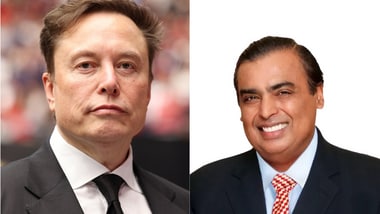
Elon Musk has promised to make Starlink satellite internet affordable in India as SpaceX prepares to enter a market dominated by Reliance Jio’s low-cost mobile data services. In posts on X on 9 and 11 October, Musk criticised Mukesh Ambani’s market dominance in India and argued that competition would benefit consumers, even if it reduced Jio’s profits. The debate has grown fiercer in the days leading up to Jio Platforms’ initial public offering (IPO), expected to be valued at approximately $106 billion.
However, in India, cheap mobile internet raises a question: How many consumers would pay more for satellite internet? Starlink may be able to make a difference in certain remote areas, but the cost of the service will determine whether more people will buy it or it remains limited to the “business and home connectivity market.”
Musk has yet to reveal the official subscription pricing of in India. According to previous media reports, it would cost around ₹3,000– ₹4,200 per month, plus the price of the hardware. These are estimates, not confirmed tariffs.
To give perspective, Sheel Mohnot, a fintech investor, commented on X that he receives 60 GB of mobile data for around $4 (about ₹350) for a month in a village in India. He questioned whether consumers would pay $27 (around ₹2,400) per month, the price he cited for Starlink in Rwanda, described as its cheapest market.
Mohnot (@pitdesi) wrote on X: “India has among the fastest and cheapest internet in the world, with remarkable coverage too…”
Further, he said that the areas with the greatest potential for benefit from Starlink are also the areas where people may struggle to afford it.
Aaron Burnett, founder and CEO of mach33, a Maryland, US-based company that designs and manufactures aerospace and robotics prototypes and mechanical systems, offered his perspective. On X, he said that the reason for the high availability of low-cost connectivity in India is mobile internet connectivity, not home high-bandwidth connectivity.
Indian users use 30-40GB of their mobile data every month, while home fibre connections use up as much as 300GB, Burnett added. He claimed that a viable alternative to fixed broadband could help stimulate demand for home broadband, but his estimates and projections were not independently verified here.
On 9 October, Musk posted on X: “Dear Prime Minister , Please accept my humble apologies for not realising that you are the real boss of India.”
On 11 October, he criticised Reliance’s supporters for saying that Starlink would not be able to beat Jio’s pricing and would be a tough competitor.
Musk posted: “The reality is that competition would greatly benefit the average citizen in India by giving them more choices, as it always does.”
He added that SpaceX would need to make Starlink affordable for Indian customers to subscribe.
Jio is working on launching a low Earth orbit (LEO) satellite network. The rivals might eventually expand broadband service, especially in areas where it is not currently available.
The difficulty for isn’t just getting into India; it’s also finding a price point that fits a market used to low-cost mobile data. If Musk wants to make satellite Internet available to more than just remote and premium customers, affordable equipment and subscription plans will be key.