



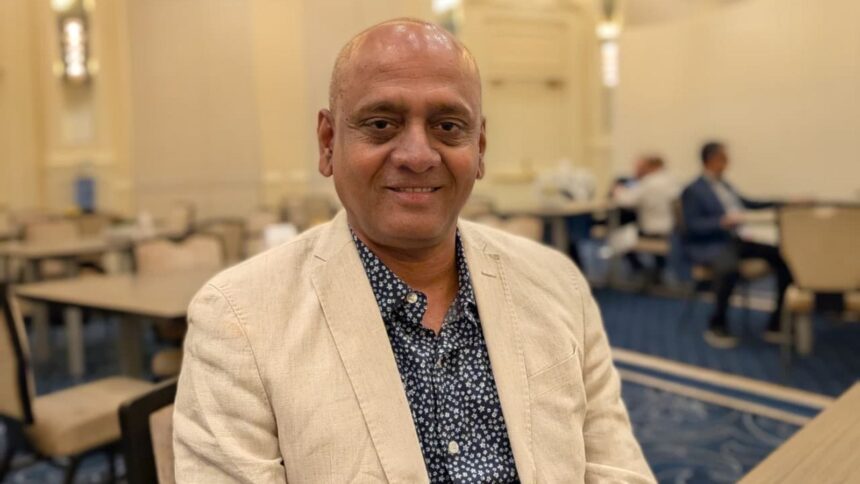
India’s sovereign artificial intelligence efforts could become a key differentiator against the US and China in the AI race, and sovereign and local-language AI systems could become the country’s real competitive advantage, according to Dell executive Satish Iyer.
“I don’t know whether necessarily having a strong frontier model is a requirement. I think at the end of the day, the differentiation on the frontier models is going to be less and less over time,” Iyer, Vice President of Innovation and Ecosystems, Dell, told indianexpress.com in an interview at the Dell Technologies World event in Las Vegas last week.
“Everyone uses a search engine, but people have their own preferences. You may have your favourite, and I have mine. The same goes for browsers. There are probably four or five really good browsers and search engines. While one may be dominant globally, that doesn’t mean it will dominate every region or every market,” Iyer said.
India is building its own sovereign AI platforms, such as Sarvam AI and BharatGen, which are developed, owned, or controlled within the country to ensure that critical AI capabilities and data remain under national jurisdiction. Though India is a major AI market, especially for US-based tech companies, with over a billion internet users and a large pool of tech talent, it still lags behind global leaders such as the US and China.
However, Iyer said than localised sovereign models when it comes to market success. He also noted that differentiation will come from regional context, language support, and vertical applications.
“I think where it actually becomes important is in how countries like India are driving sovereign models locally. Languages are important, as is bringing in vertical and regional context. I don’t think there is anyone who can do that better than India,” he said.
But even though India is an important market for US-based tech companies, the world’s most popular AI chatbots do not support all of India’s 22 official languages. ChatGPT and Claude currently support around half of them, while Gemini supports nine. This means millions are excluded from accessing the technology if these AI chatbots do not understand local Indian languages, which could create a divide and limit the benefits of AI across key sectors such as education, governance, healthcare, and banking.
Iyer sees and believes AI can improve diagnostics, care, and preventive healthcare across India’s diverse population. Agriculture can benefit from AI-driven efficiencies given the country’s vast agribusiness scale. Manufacturing also stands to gain from AI-powered automation and process optimisation. Customer support remains another key area, where AI can improve service efficiency in English-speaking back-office operations.
The world, however, still views India as an emerging AI and cloud infrastructure hub, despite a recent surge in global tech investments. Key investments are going into local cloud and AI infrastructure, as well as the creation and setup of data centres, which are centralised physical facilities that host computer servers, IT infrastructure, and network equipment. Despite concerns around water shortages and electricity, India is moving ahead with plans to set up data centre clusters across multiple states.
Iyer, based in San Francisco and responsible for ecosystem collaborations, closely monitors startup hubs in San Francisco, Israel, and , and said what makes Indian startups unique is that they balance innovation and economics.
“The innovation is off the charts. It’s really interesting to see how some startups in India are thinking about innovation, and how they blend it with economics. I think when you look at these startups, it’s not only that they are solving interesting problems, they are also thinking, ‘Can I solve it for one-tenth of the cost?’” he added.
Although Iyer did not reveal names, he said Dell is working with local Indian startups in the security and AI data space, including AI guardrails, early quantum, robotics, and physical AI.
Iyer pointed out that cost is a major challenge for enterprises in India when adopting AI.
“I hear ‘tokenomics’ about 17 times. In India, it’s a big topic because companies want to consume these models. Companies are also looking at many India-specific vertical models because India has a very rich industrial ecosystem, so they want to consume locally to keep costs down. Cost is a much bigger conversation in every enterprise discussion we are having.”
One piece of advice Iyer wants to give startups embracing AI is to understand that enterprise AI adoption is complex, requiring navigation of intricate systems, proprietary data, and strict security requirements.
“One of the key things we say is that when startups look at a problem they want to solve, it is completely different from an enterprise problem,” he said. “Enterprise challenges are much more complex. A lot of these startups are cloud-native; they start in the cloud and think they can simply transpose that into a large enterprise. It’s just not that easy. In big enterprises, data is local, proprietary, and made up of more secure datasets, and security becomes the number one posture for them.”
But as New develops its domestic AI industry, frontier AI models from US-based tech companies are far superior and continue to improve as AI advances. At the same time, the Indian government’s $1.2 billion for the AI Mission project is tiny in comparison to the multi-billion-dollar budgets of large US tech companies. Perhaps the bigger question is how far US tech companies will go to support India’s domestic AI push while also maintaining their lead in the most cutting-edge AI models and control AI tech end-to-end, including the chips needed to power AI.
The other key question is the impact AI might have on jobs, given India’s already high unemployment rate.
“India generates a large number of graduates and talented engineers. I would say: learn how to think big. Because AI can perform specific tasks very well, but there has to be someone who can stitch everything together,” Iyer said.
“I would call it systems-level thinking,” he continued. “At some point, young people entering the job market need to develop this systems-level thinking, which allows them to think about how all these things fit together in ways AI cannot. AI will never be able to do that, and only humans can. I think it’s about finding that sweet spot of understanding. Yes, I do need to know how to write Python, but I may not spend three hours a day writing Python code. AI can do that. But you have to understand where all these pieces fit together.”

