



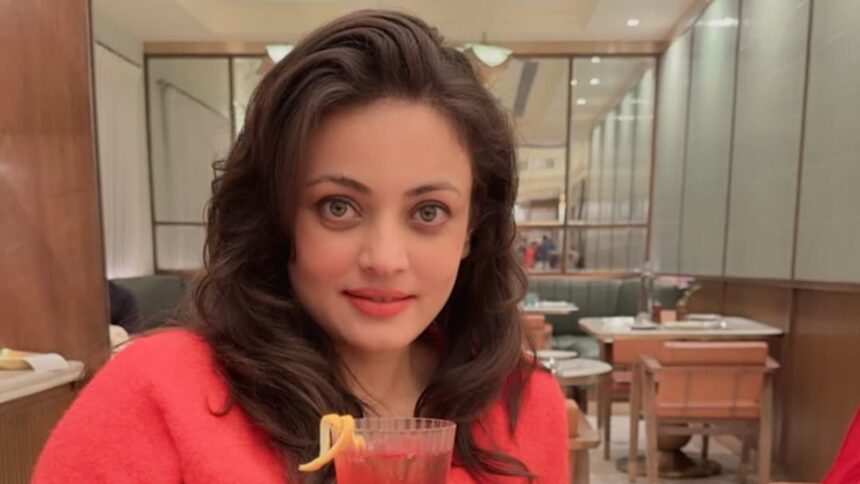
Fame can arrive unexpectedly, but when it arrives during adolescence, it can also alter the natural rhythm of growing up. Actor Sneha Ullal recently reflected on how a chance encounter completely changed the direction of her life. She revealed that acting was never part of her original plan and that she had no connections to the film industry when an opportunity unexpectedly came her way.
Recalling the moment during a conversation with AlphaNeon Studioz, she said, “I had just completed my 10th grade and newly joined college when Arpita Khan’s friends spotted me. It was around the same time they were auditioning for Lucky’s character. I am assuming they told Salman Khan about me, and then they reached out to me.”
Sneha also explained that her decision to take up Lucky was influenced by family circumstances rather than by ambition or glamour. “When I was approached for the movie, I was personally in a very bad place. My mom was undergoing treatment for cancer. The environment in our house was quite depressing. I took up Lucky to divert my family’s mind. My mom loved travelling, so . It changed a lot of things for me, irrespective of whether or not I was interested in the art,” she shared.
The transition from being a teenager to becoming a public figure was rapid, and Sneha admitted that the experience came at an emotional cost. “I received a lot of love for the movie. It was a difficult journey. That film took a lot from me, but at the same time gave me a lot too. It took away my freedom, my college life. I never got to live my teenage years or my 20s. I went from being 16 to an adult overnight. It was a compromise. I didn’t understand it then, but now I do.”
She also addressed the comparisons with Aishwarya Rai that followed her early career. “When Aishwarya Rai became Miss World, people around me would say I looked a lot like her. Later, the PR game was such that, since I debuted opposite Salman Khan, people connected the dots in that angle. But it never bothered me. I was too young for all that.”
Beyond films, Sneha spoke about feeling uncertain about her place in the industry and finding meaning elsewhere. “I would receive many offers since childhood. Every time I visited India from Oman, people from various brands would approach me. But we were extremely scared of this industry. I am not very glamorous; I’m extremely tomboyish. People often ask where this actress disappeared after Lucky, but I was never sure about acting. I was very confused. I didn’t understand the technicalities, and I was never into glamour.”
Today, she says, purpose has also come through animal welfare work. “If I weren’t an actor, I would start a business related to animals and the planet. I am an animal activist,” she shared, adding, “I am very prominent in the animal activist community. I have rescued many animals, and I hope to continue doing more.”
Psychologist Rasshi Gurnani tells indianexpress.com, “Teenage years are usually when people experiment with identity, friendships, independence, mistakes, and emotional boundaries in a relatively safe environment. When that process gets interrupted by professional pressure, public scrutiny, or adult expectations, the person often enters what psychologists call ‘premature adulthood’ or ‘accelerated maturation’.”
Outwardly, she says that they may , but internally, there can be unresolved emotional development, loneliness, emotional exhaustion, or even grief over a lost youth. “Many individuals in such situations later speak about feeling emotionally disconnected from peers because they never got to experience ordinary milestones like college life, anonymity, spontaneity, or youthful exploration. Constant visibility can also create hypervigilance, where the person feels observed all the time and struggles to relax into a natural sense of self.”
According to Gurnani, repeated comparisons during teenage years and early adulthood can deeply affect identity formation because this is the stage where self-worth is still being built. She says, “Psychologically, young people often rely heavily on external validation to understand who they are, and when they are constantly compared to someone else — whether in terms of beauty, success, popularity, or social image — it can create a fragile sense of identity.”
Over time, comparisons can lead to chronic self-monitoring, insecurity, impostor syndrome, and a feeling of never being ‘enough’ as oneself. In some cases, individuals stop developing an authentic identity because they become overly focused on either matching expectations or distancing themselves from comparisons. “This can impact self-esteem, body image, anxiety levels, and emotional resilience, especially when the person is still psychologically forming their sense of individuality,” explains the expert.

