



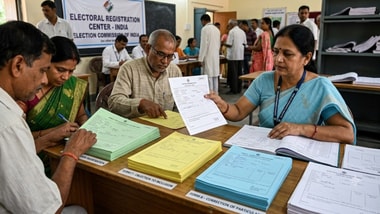
Since the started the Special Intensive Revision (SIR) of electoral rolls in June 2025, voters have had to deal with several forms to add, remove, or update names on voter lists.
Some of these forms are part of the Registration of Electors Rules, 1960, which set out how electoral rolls are prepared and revised. Others have been introduced specifically for the SIR exercise.
Here is what each form is meant for.
Form 6 is the statutory application used by a person who wants to be registered as an elector.
Under the , it has another important role. A voter whose name does not appear in the draft revised electoral roll has to use Form 6 to get their name added again. Such an application must also include a declaration.
Form 7 is used when an elector wants to challenge the inclusion of a name in the electoral roll or request that a name be deleted.
One Form 7 can be used for one electoral-roll entry, and the applicant must give a reason for the objection or deletion.
A voter can use the form to remove their own name, for example, after shifting to another address. They can also object to another person’s name being included in the roll. However, an objection against another elector can only be filed by someone whose own name is already present on that electoral roll.
Form 8 is used for several purposes. These include changing an elector’s address, correcting details in the electoral roll, getting a replacement EPIC and marking an elector as a person with disability.
However, its use during SIR has led to concerns among voters who have moved to a new address.
Many such voters have said they were asked to use Form 6, which is normally meant for adding a name to the electoral roll, instead of Form 8.
The ECI’s automated system does not accept a Form 8 application if the voter has not submitted a pre-filled enumeration form at their previous address.
Form 6A is meant for overseas electors. It allows Indian citizens living abroad to register as voters as long as they have not acquired citizenship of another country.
Form 6B, meanwhile, allows an elector to provide their Aadhaar number for authentication of their electoral-roll entry.
Submitting Aadhaar details through Form 6B is voluntary. Aadhaar details are also optional on the SIR enumeration form.
Forms 9 to 11B are not applications submitted by individual voters. They are lists maintained by electoral registration officers (EROs) and displayed on the notice board of their offices under Rule 16 of the Registration of Electors Rules, 1960.
These lists allow voters to keep track of claims and objections submitted in their constituency.
Officials authorised to receive applications also maintain these lists under Rule 15.
Under the rules, a claim or objection can be accepted without a hearing seven days after it is listed, unless someone submits a written request for an inquiry.
Form 9 contains the list of Form 6 applications received by the electoral authorities.
Form 10 records the Form 7 applications received, including objections and requests for deletion.
Form 11 lists Form 8 applications received for purposes other than a change of address.
Form 11A contains Form 8 applications submitted by voters seeking to change their address within the same constituency.
Form 11B lists Form 8 applications from voters seeking to move their registration to an address in another constituency.