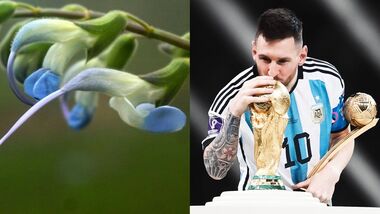
Lionel Messi has earned every possible honour on a football field for his country and the club he played for in his decorated career so far. From winning the World Cup in 2022 and two Copa America titles (2021 & 2024) with Argentina, the 39-year-old is also an eight-time Ballon dOr winner.
For Argentina, Messi made 208 appearances and finished with 126 goals, 71 assists and six official titles, which include a in Qatar, a Finalissima and more. He hanged up his boots in international football against Benin in front of his home crowd earlier this month.
Now, a recently discovered plant species has led him to a one-of-a-kind tribute: a flower named after him. It’s called Salvia messii in honor of . The plant is native to the Andes mountain range of central and southern Peru, and the October edition of botany journal Phytotaxa reported Salvia messii is an endangered species because of “restricted distribution.”
So how did it come to be named after Messi, who is a hero in Argentina, south of Peru? It’s because of the plant’s white and light blue flowers that mimic the colors of the jerseys worn by Argentina’s national team. And has worn it plenty of times since beginning his international career in 2005. The star of Major League Soccer’s Inter Miami, Messi announced his retirement from international play in August.
And why is there an extra “i” at the end of Salvia messii? The whole plant name follows the historic botanical naming convention, adding the letter to recognize the plant is named after a person. The lower-case spelling of his name is dictated by the same rule. Salvia messii means ‘Messi’s plant’
The Salvia messii belongs to Lamiaceae (known as mint family in simple words). Its subspecies is known for their antioxidant, anti-inflammatory, and antiseptic effects. The plant grows approximately 1.5 meters tall and can survive on rocky and arid slopes in a mountain range and is found between 2,000-2,400 metres above sea level.
It is an endangered plant species. the research that led to the discovery of Salvia messii, was headed by Paul Gonzales, of the Natural History Museum of the National University of San Marco, Argentinian researcher Rolando Uria, and the biologist Jean Capcha-Ramos, from Huarango Nature.
On Saturday, scored twice in the space of four minutes to lift Inter Miami to a 3-1 victory at Atlanta United on Saturday as the MLS title defense continued to gain steam with the playoffs approaching.
It was at the same Atlanta stadium where Messi helped Argentina beat England in the World Cup semifinals in July. Messi delivered two scintillating goals to secure Inter Miami’s third straight victory.