



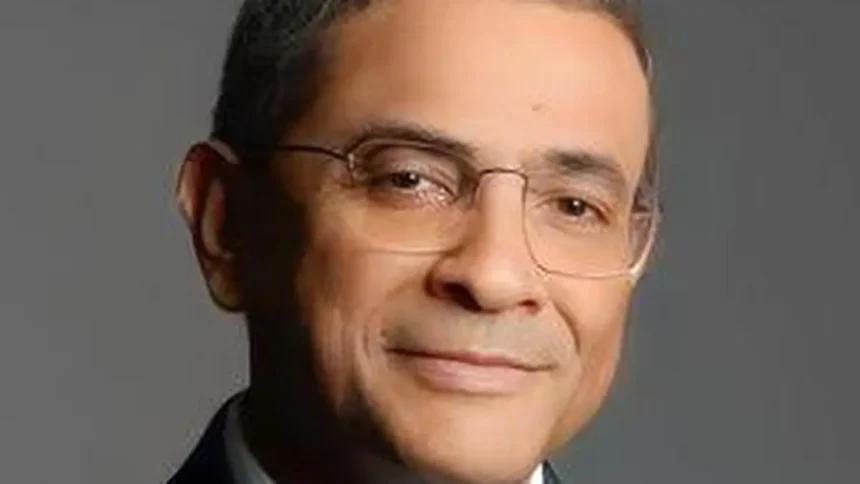
Sreedhar N, Saint-Gobain’s first non-French global CFO before taking charge of its Asia-Pacific and India business, doesn’t want to sell Indian builders just another construction product. He wants to sell them a quieter, cooler, and more energy-efficient building and believes the French group now has enough pieces of that building to do it.
“I don’t come here to sell you a product,” said Sreedhar, now Saint-Gobain’s Senior Vice-President and CEO for Asia-Pacific and India. “I will reduce the energy bill and will reduce the noise.” He can make that pitch, he said, because “I have the full solution.”
Now he is putting money behind that proposition. Saint-Gobain plans to invest ₹11,000 crore in India over the next five years, and Sreedhar is scouting for acquisitions as he pushes beyond the glass business that established the group in India into faster-growing segments such as construction chemicals and insulation.
“I am willing to acquire anything meaningful for our organisation,” he told businessline.
The investment represents a sharp acceleration. Saint-Gobain invested ₹9,900 crore in India over the previous decade. The new programme would lift its average annual investment from about ₹990 crore to ₹2,200 crore, an increase of roughly 122 per cent.
India already ranks among Saint-Gobain’s top five markets by profitability and is its fastest-growing country, Sreedhar said.
The group’s latest shareholder disclosures put India sales at €1.7 billion in 2025, with an EBITDA margin above 20 per cent. Chairman and CEO Benoît Bazin has outlined an ambition to triple the size of the Indian business over the coming decade.
Sreedhar knows the acquisition playbook. As global CFO, he was part of a transformation that reshaped about 40 per cent of Saint-Gobain’s portfolio.
Its $1.025-billion acquisition of Fosroc, completed in February 2025, brought 20 manufacturing plants and a significant Indian construction chemicals business. Alongside Chryso, GCP, and OVNIVER, it helped build a €6.5-billion global construction chemicals platform.
For Sreedhar, deals are about more than price. Preparation, speed, and giving a seller certainty that a transaction will close are critical, followed by locally driven integration. “Having local CEOs across our operations has done the magic for us,” adds Sreedhar.
The opportunity is also about penetration. He expects insulation and construction chemicals to grow particularly quickly in India, while gypsum board could open up another market as its use spreads from commercial buildings into homes.
Saint-Gobain already has 82 plants in India. Its Chennai innovation hub has 300 scientists developing products and solutions specifically for the Indian market, and Sreedhar said the team has generated 275 patents.
In Tamil Nadu, the group has committed ₹5,400 crore, comprising an initial ₹3,400 crore followed by another ₹2,000 crore, across projects in the state. The additional ₹2,000 crore is a longer-term commitment over the coming decade.
India is also becoming a base for regional markets. Stone wool made here has been qualified for Australia, while higher-value glass is supplied to Australia, Southeast Asia, and the Middle East.
Yet Sreedhar’s ambition ultimately goes beyond factories, acquisitions, or exports. He wants lighter building materials to displace some of the bricks, cement, and other heavy materials that dominate Indian construction.
“I would like to see if I can completely replace sand, cement, and brick. That would be my dream,” he said. “Can I do it? I think it’s feasible.”
For India, he conceded, that remains “a long, long way” off. “But sometimes you need to have a dream,” Sreedhar said, adding that he is here “to make some beginning.”
Published on October 4, 2026