



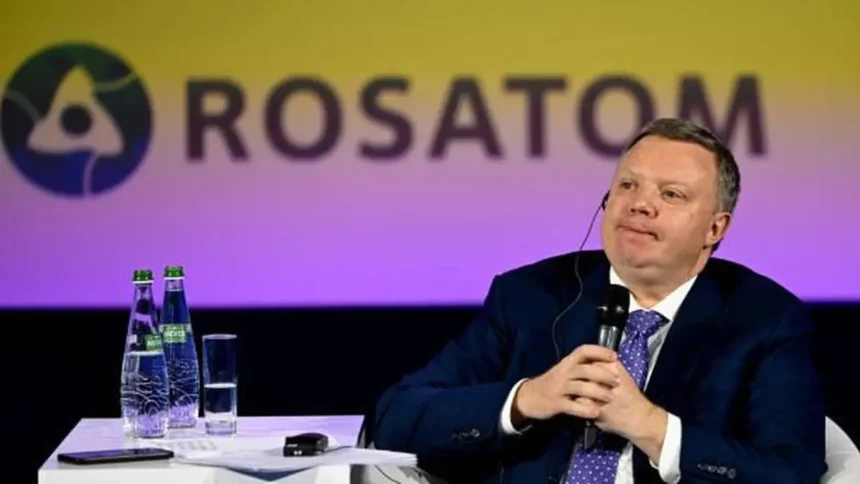
Russia’s state-owned nuclear energy corporation Rosatom is in talks with some of India’s biggest corporate and government-owned power companies, including Adani Group, Reliance, Jindal and NTPC. The company seeks to explore participation in India’s rapidly expanding nuclear power programme, Kirill Komarov, First Deputy Director General for Corporate Development and International Business at Rosatom, told businessline.
The development follows India opening its nuclear power sector to wider private participation through the Sustainable Harnessing and Advancement of Nuclear Energy for Transforming India (SHANTI) Act, 2025, and seeks to increase nuclear capacity from the current 8.78 gigawatt (GW) to 100 GW by 2047.
“We now have talks with a lot of companies from the private sector, including all your famous names like the Adani Group, Reliance and Jindal, and your state-owned company NTPC,” said Komarov. “All of them are interested in having access to nuclear technologies.” Private participation, he said, will allow more companies to invest and build capacity alongside state-owned enterprises.
Rosatom, which accounts for about 20 per cent of Russia’s power generation, ranks first globally in terms of the order portfolio size for constructing nuclear power plants, with 46 units at various implementation stages across 10 countries, including China, India, Bangladesh, Türkiye, Egypt, Hungary, Iran, and Kazakhstan.
The Indian government has been pushing for nuclear energy as it is a base load source of electricity available round the clock, with lifecycle emissions comparable to renewables such as hydro and wind power. It is also uniquely placed to meet always-on power needs of data centres, advanced industries and emerging technologies.
Currently, the domestic nuclear power capacity accounts for a mere 1.6 per cent of India’s total installed capacity of 556.85 GW. Coal accounts for 45.35 per cent and renewable energy makes up 43 per cent.
Komarov emphasised that the scale of the target makes it necessary to bring more companies into the sector. “Such an ambitious task is very difficult for only one company,” he said, referring to the Nuclear Power Corporation of India (NPCIL), which currently operates and is building most of India’s nuclear fleet.
“It’s very good if your government decided to invite into the nuclear sector, not only state-owned companies but private companies, too, because you need a lot of companies who will construct, operate, invest money, put in effort and resources to do these very complicated things,” he noted.
For Rosatom, the opportunity is not limited to supplying reactors. Komarov said localisation will be central to India’s nuclear expansion, adding that the scale of the programme makes it impractical to rely on imported equipment and materials. “I think the key element of success for your country is your localisation [Make in India] programme. For such an ambitious programme, you need to be able to not only import all equipment and materials but also produce a majority of these things in India.”
Rosatom, he said, had already reached 50 per cent localisation at Kudankulam in Tamil Nadu, and was ready to replicate the model with new Indian companies entering the nuclear sector.
As one of the world’s largest integrated nuclear energy companies, with operations spanning reactor construction, nuclear fuel, uranium mining and the wider nuclear fuel cycle, Komarov stressed on Russia’s experience as a nuclear power technology and services exporter. Of its 32 nuclear units currently under construction globally for export, Komarov said 28 were based on Russian designs. Rosatom, he added, had also constructed about 20 nuclear power plants over the past two decades.
Published on September 29, 2026