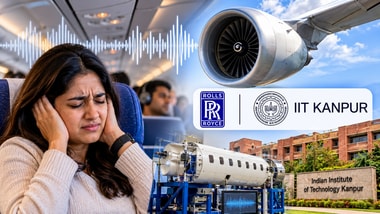
Despite advances in aircraft engine technology, cabin noise remains an engineering challenge for the aviation industry. Engine vibrations can travel through an aircraft’s structure, creating noise inside the cabin and affecting passenger comfort. Rolls-Royce and the Indian Institute of Technology (IIT) Kanpur are now working together to better understand this problem and explore ways to reduce it.
The two institutions on Wednesday announced a six-month joint research project focused on understanding structure-borne noise arising from engine vibrations, according to PTI.
The research will involve validating a numerical methodology developed by Rolls-Royce through an experimental test-rig setup at IIT Kanpur. The findings could help researchers better understand how vibrations travel through aircraft structures and inform future noise-reduction strategies.
Modern jet engines have incorporated advanced technologies to reduce noise and improve performance. However, engine noise is not the only source of sound experienced by passengers inside an aircraft.
Vibrations generated by an engine can travel through the aircraft’s structural components, including the fuselage. These vibrations can cause different parts of the aircraft structure to resonate, producing sound that passengers may hear inside the cabin.
This is known as structure-borne noise. Unlike noise that travels directly through the air, structure-borne noise is transmitted through solid structures before becoming audible inside the cabin.
Understanding how these vibrations travel and interact with cabin acoustics is important for developing more effective noise-reduction strategies.
Rolls-Royce engines such as the Trent XWB are known for their advanced technology and low-noise features, which are designed to offer greater comfort and safety to airline customers. However, the latest research with IIT Kanpur will examine how engine-induced vibrations affect cabin noise and how this impact could be further reduced, the company said.
The six-month project will follow a systems engineering approach and establish an experimental aircraft fuselage model designed as an integrated system of systems.
According to the statement, the setup will imitate an aircraft in flight, with a mechanical vibration source representing an engine.
Researchers will combine this vibration source with an array of advanced acoustic and vibration sensors. This will allow them to study how structure-borne vibrations interact with cabin acoustics as part of a unified system.
The experimental test rig at IIT Kanpur will be used to validate a numerical methodology developed by Rolls-Royce. The exercise is expected to generate insights into vibration transmission and the relationship between engine-induced vibrations and noise inside an aircraft cabin.
The project is being undertaken as the first phase of the collaboration, with the possibility of subsequent phases, the statement said.
The research project follows a broader industry-academia partnership between Rolls-Royce India and IIT Kanpur, formalised through a memorandum of understanding (MoU) earlier this year.
The agreement provides a framework for collaboration in research, joint projects, internships, knowledge exchange and skill development.
Rolls-Royce India Executive Vice President Sashi Mukundan said partnerships with academic institutions play an important role in advancing research, developing skills and fostering next-generation talent.
He said the collaboration with IIT Kanpur would help strengthen an ecosystem for innovation and support India’s ambitions in advanced engineering, research and manufacturing.
Mukundan also highlighted the company’s efforts to expand internships and knowledge-sharing initiatives, giving students hands-on experience in addressing real-world engineering challenges.
IIT Kanpur Director Manindra Agrawal said the project would combine numerical methodology with experimental validation to investigate an important aspect of aircraft cabin comfort.
He added that the initiative would strengthen the institute’s deep-tech ecosystem by connecting research capabilities with industry requirements and creating pathways for technology development and talent building.