



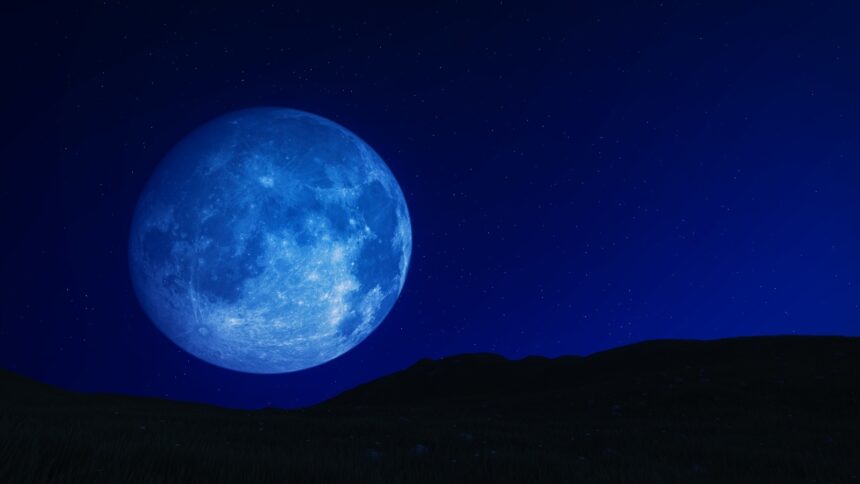
Skywatchers across the world are set to witness a rare “Blue Moon” this weekend when the second full moon will appear within a single calendar month.
The celestial event will reach its peak on May 31, though astronomers say the best viewing opportunity may be during moonrise on the evening of May 30, when the Moon will appear low on the horizon shortly after sunset.
Despite its name, a Blue Moon does not actually appear blue. Instead, the Moon is expected to glow in warm orange and golden hues near the horizon due to Rayleigh scattering — the same atmospheric phenomenon responsible for colourful sunrises and sunsets.
A Blue Moon occurs because the lunar cycle lasts around 29.5 days, while calendar months are slightly longer. Occasionally, a full moon appears early in the month, allowing enough time for a second full moon before the month ends.
That is the case in May 2026. The month’s first full moon, known as the Flower Moon, occurred on May 1, making the May 31 full moon a “monthly Blue Moon”.
For skywatchers in India, the blue moon on 31 May 2026 will rise in the eastern sky shortly after sunset, and it will be visible without a telescope.
Astronomers also recognise a “seasonal Blue Moon”, which refers to the third full moon in an astronomical season containing four full moons. The next seasonal Blue Moon is expected on May 20, 2027.
The upcoming event is relatively rare. After this weekend, the next monthly Blue Moon will occur on December 31, 2028.
Experts recommend watching the Moon from a location with a clear eastern or south-eastern horizon shortly after dusk for the best experience. While the phenomenon will be visible to the naked eye, binoculars or small telescopes can offer a closer look at the lunar surface.
The rare full moon event is expected to attract astronomy enthusiasts and casual skywatchers alike, making it one of the most anticipated celestial events of 2026.

