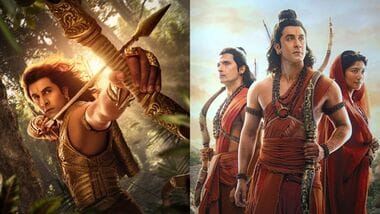
Namit Malhotra’s has drawn attention at the box office since its release on November 5, with the first instalment reportedly earning around ₹350 crore. But beyond its scale and visual effects, the film also involved years of work by traditional artisans.
One example is the armour worn by and as Lord Rama and Lakshman in a battle sequence involving the armies of Khar and Dushan. Made using cane and rubber, the pieces were handcrafted by a team of 15 artisans from Assam, led by master artisan Jaynal Abdin.
Abdin, who hails from Jania Banglipara village in Barpeta district, told ANI that his team made around 30-35 pieces over three to three-and-a-half years.
The project reached Abdin through Abdul Malek of the local organisation Gram Unnayan in Jania, rather than directly from the film’s production team.
“it first came to Abdul Malek ji of Gram Unnayan here in Jania. He called me over and said a project had come in and asked me to take a look. They had initially sent a file containing the drawings and designs,” he said.
After reviewing the designs, Abdin agreed to take up the work and discussed the project with his team leader. A group of representatives subsequently visited the village, with a member named Sagar staying back to oversee measurements and corrections.
The initial designs, however, needed adjustments. The first set of armour pieces had fitting issues and had to be returned. The pure cane construction also proved too rigid for actors to move comfortably during action sequences.
“After we fixed the initial cuts, they made the main actor of the film wear it, and he said it was very hard and tight, which cane naturally is. They asked what alternative material could be used. I told them we could craft it from whatever material they provided,” recalled Abdin.
The production team subsequently supplied black and green rubber as an alternative material. However, weaving rubber alone did not deliver the required result.
Abdin then proposed combining the two materials. “When I spoke to costume designer Ajay, I suggested using half cane and half rubber. He agreed and asked us to make one sample,” the Assam-based artisan remembered.
The hybrid design was eventually approved. The team then had to manage production around the film’s shooting schedule, with requests sometimes arriving after long gaps.
“The work was continuous; sometimes there would be no news for three to six months, and then suddenly a call would come asking for eight or ten pieces on very short notice before shooting resumed,” Abdin told the agency.
Abdin said the artisans initially did not know that their work was intended for Nitesh Tiwari’s Ramayana. They had been told only that the armour was for a film shoot and that their contribution could bring them recognition later.
“Now that the film has been released, we finally know the truth. I have not watched the film yet, but I will definitely watch it because a small part of my own handiwork is in it,” the artisan concluded.