Ramayana review: With grandiose visuals, elaborate battle sequences and an ambitious retelling of one of India’s greatest epics, makes a strong case for the theatrical experience. The two-part film comes with high expectations thanks to its massive ₹4,000 crore budget. But while the spectacle helmed by Nitesh Tiwari is impressive, the casting and emotional depth leave room for debate.
Producer ‘s Ramayana is a film made for the big screen in every true sense. From its grand visual canvas and elaborate sets to its flying sequences and battle choreography, the film makes a strong attempt to bring the scale of the epic to life. The music by AR Rahman and Hollywood legend Hans Zimmer plays a significant role in the film. The music often lends the narrative the gravitas and emotional weight that its larger-than-life moments demand.
However, translating a story as culturally and spiritually significant as the Ramayana into a cinematic experience is no easy job. And while the film gets several things right, it also makes some creative choices that may divide people.
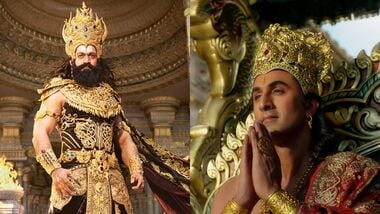
One of its biggest strengths is its treatment of Ravana. makes a commanding impression with the dedicated introduction that establishes the character with considerable brilliance. Apart from this, the filmmaker’s attempt to explore Ravana’s mind and reveal his ten-headed personality is commendable. Rather than relying solely on his physical presence and reputation as the antagonist, the narrative offers glimpses into the complexity of his character, adding another dimension to the portrayal.
is another standout in the film. His camaraderie and screen presence bring a certain warmth to the narrative, leaving the audience with a smile from time to time.
With limited dialogue, Sheeba Chaddha as Manthara deserves a special mention. Arun Govil’s portrayal of Raja Dashrath lends the narrative emotional depth, capturing the dilemma of a father torn between his dharma and love for his son.
The climax battle between Jatayu and Ravana is visually impressive and emotionally charged. However, the aftermath of the battle could have benefited from a stronger emotional response from Ram, who looked rather blank and even untroubled after Sita haran (abduction).
The casting of as Ram is perhaps one of the film’s more debatable aspects. It is a mixed experience. There are moments when Kapoor fits the character’s composure and understated nature. However, there are also instances when his performance feels too restrained and even too stoic. I particularly expected emotionally charged moments, including Jatayu’s death; at least some expressions of grief and anguish.
Sai Pallavi brings inherent grace and innocence to the character of Sita; the qualities that make her a natural fit for the role’s gentleness. However, the casting somehow feels incomplete. While she captures Sita’s softer qualities, she lacks the radiance, screen presence and larger-than-life aura in a few scenes that many like me associate with Mata Sita. Maybe a little more screen time and interaction with other characters other than just Ram.
The film makes some interesting additions and alterations to familiar episodes. Sita’s portrayal as someone knowledgeable in warfare, farming and the arts makes her character more active. Her knowledge of astras and her agency in certain moments are welcome touches.
The Shiv Dhanush sequence is another memorable episode. Sai Pallavi’s ‘Ye pariksha shakti ki nahi, bhakti ki hai’ dialogue gives the scene a spiritual dimension. Ram lifting the bow single-handedly, Sita praying for the moment, and his immediate act of bowing down after breaking it capture the essence of dharma in the Ramayana.
The film also builds on the relationship between Ram and Vishwamitra, leading to the latter’s desire to equip Ram with knowledge and make him Mahapurush and Maryada Purushottam. However, some narrative transitions could have been better developed here.
The absence of a more detailed sequence showing Lakshman’s decision to accompany Ram and Sita, and his own sacrifice to serve his brother, for instance, makes that transition almost abrupt.
There are also moments where the film’s visual ambition takes precedence over emotional storytelling. Some scenes are undeniably spectacular. Though one should keep in mind that spectacle cannot always replace character development.
Ramayana has ambition, scale and several genuinely memorable cinematic moments. Yash’s Ravana, Ravi Dubey’s performance, the Jatayu battle and the exploration of Ravana’s mind stand out easily. Its music and visual design make it an experience best enjoyed in the premium format; a full paisa-vasool decision.
Yet, for a story that has lived in the collective consciousness of generations, the expectations are heavy. While the film succeeds in creating a grand cinematic world, it does not always manage to give its characters the emotional depth that the monumental story deserves. It may leave you wanting a little more soul and even a glimpse of Lord Hanuman, which the audience has to wait for two years.