



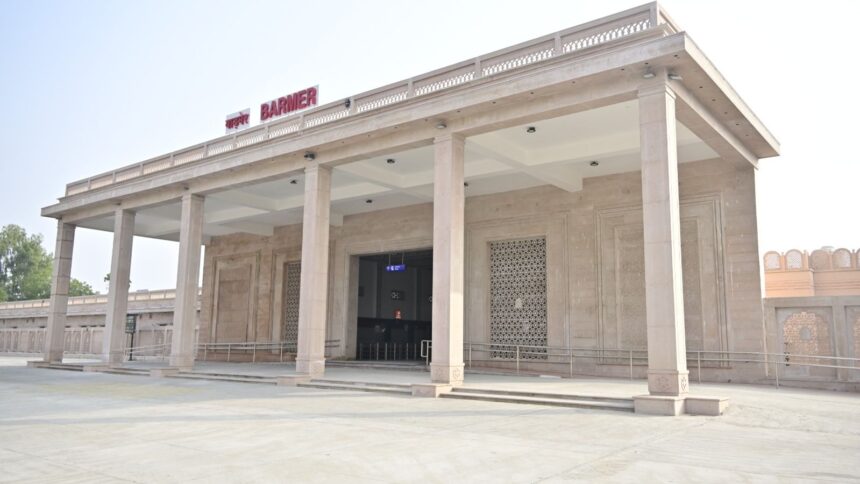
Redevelopment of Barmer railway station: The redevelopment work at under Amrit Bharat Station Scheme (ABSS) has been completed. The stations falls under the administrative control of Jodhpur Division of North Western Railway (NWR). Presently, Barmer Railway Station serves as a halt for 28 trains, with an average of 7,603 passengers travelling from the station daily.
Launched in 2022, the ABSS aims at development and upgradation of stations over the Indian Railways (IR) network. The scheme has a long-term vision that involves creating master plans, promoting multimodal connectivity, better station accessibility for passengers, etc.
Speaking to IndianExpress.com, Amit Sudarshan, Chief Public Relations Officer (CPRO) of North Western Railway, said that the redevelopment of Barmer railway station is almost complete. “Redevelopment of Barmer railway station has almost completed and ready for inauguration,” he said.
According to NWR, there has been a continuous rise in rail passenger traffic in Barmer following the presence of oil and gas (Mangala field), energy (JSW), and mineral extraction (Bentonite, Gypsum, Salt) industries. These industries have given a boost to the local economy.
The Barmer Railway Station has been redeveloped at a cost of around Rs 16.18 crore. The station has been equipped with modern facilities designed to ensure a convenient, accessible, and superior travel experience for passengers. Following this redevelopment, Barmer Station will play an important role in the socio-economic advancement of the region.
The redevelopment works undertaken at the station include a modern circulating area with separate entry and exit gates, extensive landscaping, dedicated parking zones for autos, two-wheelers, and four-wheelers, a designated drop-off/pick-up porch for passengers, and a wide, double-height main entrance.
Apart from these, there are separate and upgraded waiting halls for men and women, retiring rooms and dormitories, a new VIP guest lounge, and a Station Superintendent’s office.
Other improvements include the installation of elevator facilities on the existing Foot Over Bridge (FOB), aesthetic beautification of the station’s façade, a new 12-meter-wide FOB, new platform shelters, accessible toilet blocks and drinking water booths for persons with disabilities, improved signage and hoardings across the station, among others.

