



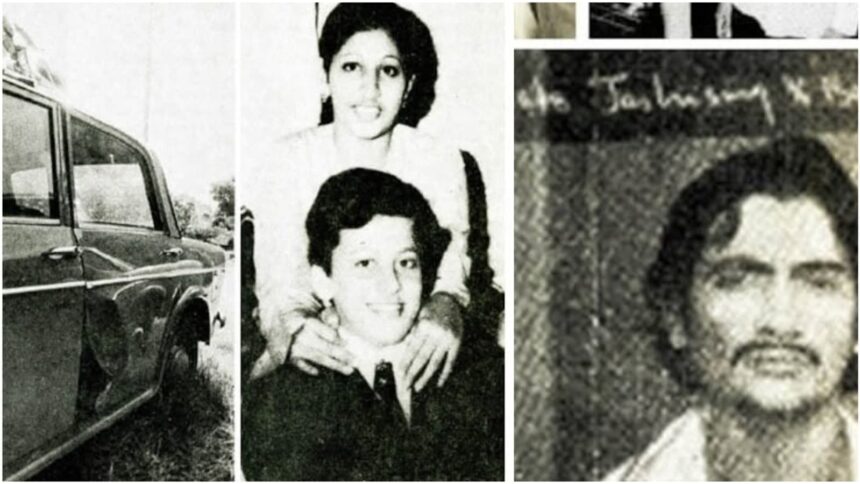
On a rainy August day in 1978, Geeta Chopra and her little brother Sanjay Chopra left home to participate in an All India Radio show. But the siblings never made it.
Their torture and killing by two men, Ranga and Billa, haunted generations and left a nation scarred.
Amazon Prime Video’s ‘Raakh’, starring Ali Fazal and Sonali Bendre, which premiered on June 12, has revived the spotlight on the horror of Ranga-Billa nearly five decades after the kidnapping and murders.
The children of a Navy Captain, Geeta (16) and Sanjay (14), lived at the Officers’ Enclave at Dhaula Kuan, New . Geeta was a second-year commerce student at Jesus and Mary College and Sanjay studied at Modern School.
On August 26, the children left around 6.15 PM for the show, ‘Yuv Vani’ (voice of the youth), which was to air at 8 PM.
When Captain Madan Mohan Chopra and his wife turned on the radio to listen to their daughter, they were surprised to hear a different voice. Thinking they had tuned in to the wrong programme, the couple tried other stations, but in vain.
Captain Chopra took his scooter and reached the AIR studio, where the children were supposed to wait for him. He learnt that they had never showed up. Alarmed, he searched everywhere in the vicinity and even went to the Willingdon Hospital (now Dr. Ram Mahohar Lohia Hospital) and the Parliament Street Police Station nearby. Friends of the children and relatives could offer no answers either. Fearing something was really wrong, Captain Chopra called the Police Control Room at 10.15 PM to report his children missing.
ALSO READ |
That evening, Kuljeet Singh, alias Ranga, and Jasbir Singh or Billa, were cruising Delhi’s roads in a car (number HRK 8930). It was a stolen one with a fake number plate. They had only one goal – kidnap children, demand ransom, and kill if anything went wrong. And things went very wrong, very quickly.
They spotted the Chopra children on their way to the AIR office.
Ranga and Billa offered Geeta and Sanjay a ride. The children, eager to reach early, fell for it. In a few hours, they would be dead.
A Supreme Court order upholding the sentencing of Ranga-Billa, noted: “The accused had loosened the handles of the doors of the car so that they should fall down when the children, after getting into the car, close the doors behind them. By this process it was ensured that the children would get into a trap like helpless mice.”
When Ranga and Billa realised their captives were the children of a naval officer, they panicked. They decided to kill the siblings.
The children, tortured for hours in the car before being dragged into a park, fought hard. Their struggle was seen and reported by multiple witnesses. One of the witnesses even chased the car in which the children were being attacked, but he failed to catch up. He then reported the incident to the police around 6.45 PM, but it took the cops one hour to take the first action of alerting the Control Room.
ALSO READ |
The Delhi High Court observed during the trial: “… we are constrained to observe that the lives of the two children could have been saved if the police had acted promptly.”
Sanjay and Geeta were taken to a deserted area in central Delhi and subjected to unimaginable cruelty in their final hours. But they fought back, so fiercely that Billa had to get stitches. The Supreme Court, during the hearing of Ranga Billa’s appeal on April 21, 1981, remarked: “The impediments here where the uncommon courage of the brave little children who did not make an abject surrender to their destiny and the stark fact which emerged during their molestation that their father was a mere government servant whose salary was too small to permit the payment of a handsome ransom.”
The Indian Express report from the day read: “Geeta Chopra, 17, and her brother Sanjay, 15, who were kidnapped near their house in Dhaula Kuan Service Officers enclave, were found murdered in the bushes along the Upper Ridge Road early morning. Both bodies bore multiple stab wounds and were in a state of decomposition. The postmortem report says that the deaths were due to injuries inflicted by a sharp-edged weapon. The time of death has been fixed between 6.15 pm and midnight on Saturday night.”
The siblings’ bodies bore multiple cuts and fractures. It emerged that the killers took Sanjay out of the car and made him sit on the road some distance away. He was later hacked to death. Sanjay’s body had 21 injuries.
Ranga’s submission recorded in the Delhi High Court order read: “I lifted the sword and aimed to hit. The boy was shivering and as such the sword-blow hit on the left arm. The boy started raising an alarm to the effect, “Mat maaro, mat maaro, kyon maartey ho” (The boy raised an alarm to the effect, “Do not kill me, Do not kill me… why are you you killing me”). Billa snatched away the sword from my hand and addressing me as ‘Beh**de Kh****’ stated that neither I knew anything to do nor I was capable of doing anything. Saying this he started killing the boy. He went on striking wherever he could. He made the boy bleed profusely. For 10 minutes Billa continued to strike the boy.”
Geeta Chopra was allegedly sexually assaulted, according to the statements of the convicts.
The High Court order said: “Immediately after killing Sanjay, the appellants had no compunction in raping Sanjay’s helpless sister by stripping her naked. After satisfying their beastly lust, they killed her and throw her body in the bushes. Evidently the appellants had a fiendish sadistic pleasure in committing the crime.”
While Ranga claimed that Billa killed Geeta, Billa blamed his partner. “At about 9.30 PM Sanjay and Geeta were killed in the jungle of Upper Ridge Road at a place between Buddha Jayanti Park and Shankar Road Upper Ridge Road roundabout,” the order document read.
The bodies were found on August 28, 1978. Police surgeon Bharat Singh, who conducted Geeta’s autopsy, said in court: “Since the body was in a state of advanced decomposition, maggots were crawling on the body.”
Billa had a cut on his head from the scuffle with the children in the car. He went to Willingdon Hospital and got treatment under a fake name. When he was caught, the medical report of the cut was used to verify his statements and used as evidence in the trial. His fingerprints on the X-ray slip were also matched.
The murders sent shock and rage through the country. It had far-reaching consequences, spilling onto elections.
Ranga and Billa evaded arrest for weeks. They were finally caught boarding a Kalka Mail coach meant for army personnel on September 8, 1978.
They were convicted by the Delhi High Court on November 16, 1979, on charges including murder, common intention, kidnapping, kidnapping with unlawful confinement, and kidnapping a woman with intention of sexual intercourse.
Ranga and Billa appealed to the Supreme Court, which confirmed their conviction in 1981, using strong words: “Their inhumanity defies all belief and description… The survival of an orderly society demands the extinction of the life of persons like Ranga and Billa who are a menace to social order and security. They are professional murderers and deserve no sympathy even in terms of the evolving standards of decency of a maturing society. We, therefore, vacate the stay orders in regard to the execution of the death sentence imposed on the petitioner and once again uphold the death sentence imposed upon him. We hope that the President will dispose of the mercy petition stated to have been filed by the petitioner as expeditiously as he finds his convenience.”
Ranga and Billa’s mercy petitions were rejected by then President Neelam Sanjiva Reddy. The case went on to become a defining moment for India’s “rarest of rare” doctrine in capital punishment. Ranga and Billa were hanged at Tihar Jail, New Delhi, on January 31, 1982.
The victims were posthumously awarded the Kirti Chakra. The Sanjay Chopra Award and the Geeta Chopra Award are given every year to children below 16 for outstanding acts of bravery.

