



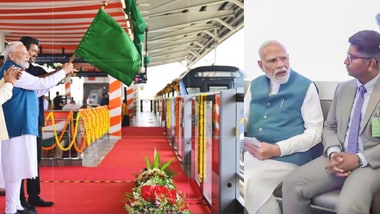
on Sunday flagged off the 15-km Vadapalani–Poonamallee Metro Rail stretch in Chennai, Tamil Nadu, and took a ride on the metro along with Tamil Nadu Chief Minister C. Joseph Vijay. The newly opened stretch, part of Corridor 4 of Chennai Metro Phase 2, has been constructed at a cost of around ₹4,900 crore, and is expected to reduce travel time for commuters travelling between Chennai’s western suburbs and the city centre.
The stations covered under the new are Poonamallee Bypass, Poonamallee Bus Stand, Poonamallee Government Hospital, Karayanchavadi, Kumananchavadi, Kattupakkam, Iyappanthangal, Thelliyaragaram, Porur Bypass, Porur Junction and Vadapalani.
According to Chennai Metro Rail, regular passenger services on the stretch will commence at 4 pm on Sunday, with trains operating in both directions until 9 pm.
From October 12, regular services on the stretch will be available from 7 am to 9 pm in both directions.
The last train will depart at 9 pm from both terminals: Poonamallee Bypass Metro and Vadapalani Metro on Corridor 4.
The Poonamallee–Vadapalani stretch is expected to strengthen metro connectivity between Chennai’s western suburbs and the city centre. A key feature of the corridor is its 3.7-km double-decker structure, along with advanced signalling systems designed to enable driverless train operations.
The new stretch is expected to ease daily commutes, improve connectivity and reduce travel time for passengers travelling along the route.
PM Modi and CM Vijay also laid the foundation stone for the development projects at an event held at IIT Madras.
The projects include National Highways initiatives worth around ₹3,700 crore, projects related to Chennai Port, Kamarajar Port and V O Chidambaranar Port, and the development of Amrit railway stations. The Prime Minister also dedicated the Sudha Gopalakrishnan Brain Centre (SGBC) at IIT Madras to the nation.
SGBC is a pioneering global scientific mission to map more than 100 human brains into three-dimensional atlases at cellular resolution, covering the human lifespan, from the foetal stage to old age.
The Prime Minister also released C-STROKE, a one-of-a-kind human ischaemic stroke atlas. Featuring more than 1,000 annotated microscopic sections from a stroke-affected brain, the atlas will help researchers worldwide identify novel therapeutic targets.
(With inputs from news agencies)