



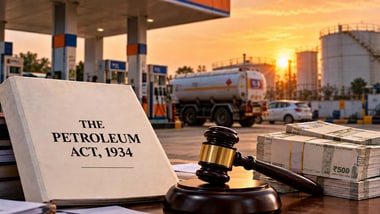
The government has proposed a major overhaul of the penalty framework under the Petroleum Act, 1934, seeking to take routine licence-related violations out of the criminal law framework while introducing steeper penalties for serious offences.
The Ministry of Petroleum and Natural Gas on Wednesday released the draft Petroleum (Amendment) Bill, 2026, for public and stakeholder consultation. Comments and suggestions on the proposed legislation can be submitted until October 30.
One of the main proposals is to treat breaches of licence terms and conditions as regulatory violations rather than criminal offences.
Under the proposed Section 23C, an adjudicating officer could impose a civil penalty of up to ₹2.5 crore for the first breach. For a second or subsequent breach, the penalty could go up to ₹5 crore.
The adjudicating officer could also direct the licence holder to take corrective action or comply with the relevant requirement. In addition, recommendations could be made to the licensing authority for suspension, revocation or curtailment of the licence.
The proposed penalties would be separate from any other liability arising from the violation.
The government said the existing framework under Section 23 creates a broad offence provision under which breaches of licence conditions can become criminal offences.
The draft seeks to distinguish between regulatory non-compliance and conduct that poses more serious risks to petroleum operations, public safety or critical infrastructure.
The Petroleum Act’s offence framework has remained largely unchanged since its last major amendment in 1970. The government has said penalties that were significant at the time have become inadequate given the scale and value of the petroleum sector today.
For context, the government noted that petrol cost around ₹0.90 per litre in 1970, compared with roughly ₹95-105 in 2026, an increase of more than 10,000%.
While some licence breaches would be moved to the civil penalty framework, the draft proposes specific criminal penalties for more serious violations.
Carrying out an activity that requires a licence without obtaining one could attract imprisonment of up to three years, a fine of up to ₹25 crore, or both.
If the violation continues, an additional penalty of up to ₹10 lakh per day could apply.
The draft also proposes punishment for obtaining a licence fraudulently through misrepresentation, impersonation or other dishonest means.
The proposed Bill separately deals with offences involving damage to petroleum facilities, pilferage and acts that endanger public safety.
For a first offence, the proposed punishment could extend to five years’ imprisonment or a fine of up to ₹15 crore, or both.
For a second or subsequent offence, imprisonment could extend to seven years, while the fine could rise to ₹25 crore.
Damage to critical petroleum infrastructure could attract imprisonment of up to 10 years, along with a fine of up to ₹25 crore or the cost of the loss, destruction or damage, whichever is lower.
The draft Bill is currently at the consultation stage and is not yet law. The government has invited comments and suggestions from stakeholders and members of the public until October 30, 2026. The feedback will be examined before the legislative process moves forward.