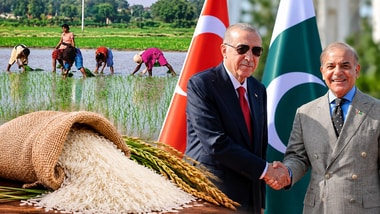
Pakistan has secured geographical indication (GI) recognition for its basmati rice in Turkey, a country that has maintained close diplomatic ties with Islamabad and repeatedly backed its position on Kashmir at international forums.
But while the registration marks a gain for Pakistan, changes to the geographical boundaries in its application could offer India’s Madhya Pradesh a fresh argument in its long-running bid for basmati GI recognition.
The Turkish Patent and Trademark Office registered Pakistan’s basmati rice under the category of Mahreç İşareti on January 2, 2026.
The application was submitted by Trade Development Authority on February 6, 2024, under registration number 1810.
This comes as Turkey and Pakistan are recently sharing close political and diplomatic relations, with both countries frequently supporting each other’s positions on regional and international issues.
However, for India, the more significant aspect of the registration is the geographical description of Pakistan’s basmati claim — and the changes made to it.
Pakistan’s original application included Pakistan-occupied Jammu and Kashmir () among the areas where basmati is cultivated. The revised registration no longer lists PoJK. Instead, it identifies specified districts across Punjab, Sindh, Khyber Pakhtunkhwa and Balochistan as recognised production areas.
The inclusion of districts in Sindh and , beyond Pakistan’s traditional Punjab basmati belt, is particularly relevant to India’s case for recognising basmati grown in Madhya Pradesh.
Madhya Pradesh has for years sought the inclusion of 13 districts in India’s basmati GI recognition.
Its demand has faced resistance on the grounds that the state lies outside the traditional Indo-Gangetic belt associated with basmati cultivation.
The Assistant Registrar rejected the state’s request in March 2018. The dispute subsequently reached the courts, with petitions concerning Madhya Pradesh’s inclusion continuing before the
Pakistan’s Turkish registration could give an additional comparative argument.
The revised geographical description recognises specified basmati-growing districts across four Pakistani provinces, rather than limiting the production area to Punjab.
This raises an important question for India’s GI framework: if Pakistan’s claim can encompass geographically diverse production areas, why should Madhya Pradesh’s claim not be assessed on the basis of its own agricultural and geographical evidence?
Pakistan’s registered specification refers to factors such as soil, water availability, climate, humidity and sunshine to establish the relationship between basmati rice and its production areas. These factors could also be relevant when assessing the quality and distinctiveness of basmati cultivated in.
Pakistan’s registration in does not automatically alter India’s basmati boundaries or guarantee recognition for Madhya Pradesh. Nor does a foreign GI registration constitute a binding legal precedent for Indian authorities or courts.
Nevertheless, the revised geographical description offers Madhya Pradesh another point of comparison in its continuing fight for recognition. It could help the state challenge the argument that cultivation and geographical recognition must remain confined to a narrowly defined traditional belt.
India must, however, build its case on robust scientific, geographical and agricultural evidence while safeguarding the identity and international reputation of Indian basmati.