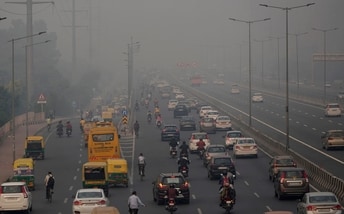
The Supreme Court has indicated that it favours restricting vehicle movement in Delhi to those that comply with Bharat Stage 6 (BS6) emission norms, as the national capital continues to struggle with severe air pollution.
A bench headed by Chief Justice of India Surya Kant on Monday, November 23, raised concerns over the limited involvement of neighbouring states and stressed that tackling the pollution crisis requires coordinated action across the National Capital Region (NCR).
Justices Joymalya Bagchi and V. Mohana expressed their willingness to allow only BS6-compliant vehicles in the National Capital, even though it is not yet proposed to be extended to the entire NCR. The court also emphasised measures to curb vehicle emissions and ensure that commercial vehicles do not enter the capital, ET Auto reported.
“We are clear; we will allow only BS-VI vehicles in Delhi, if not NCR,” the bench orally observed during Monday’s hearing.
However, the Supreme Court did not issue an immediate order enforcing the proposed restriction. It said it would look into the issue alongside other short- and long-term initiatives to reduce air pollution.
If the court ultimately adopts the restriction, it could have a major impact on non-conforming vehicle owners.
The Bench also recommended that the entry of commercial vehicles in Delhi be phased out gradually. Rather, it was suggested to establish warehouses near the city’s borders, from which the necessary goods would be offloaded and then transported into the capital by smaller battery-powered or non-polluting vehicles.
Surya Kant also admitted that such a transition would take time and proposed considering a 5-year timeline to build the infrastructure.
He also clarified that restrictions on commercial vehicles should not disrupt the supply of essential goods, including vegetables, fruits, and other daily necessities.
The Supreme Court also expressed concern about the “passive role” of adjoining states in addressing pollution issues in . The bench pointed out that Delhi can’t be held responsible for a problem that is common to the whole region.
It observed that neighbouring states could not remain “backbenchers” when coordinated efforts were needed to improve air quality.
The court asked the advocates general of the states of Punjab, Haryana and Uttar Pradesh to attend the proceedings. It also requested reports from the states on action taken to curb particulate pollution and enhance air quality.