



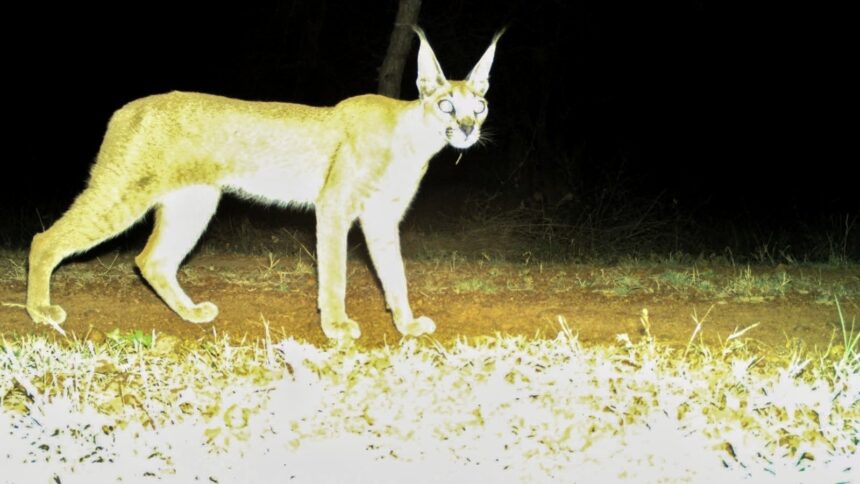
One of India’s rarest wild cats, the Caracal, was recently captured on a camera trap in Kuno National Park, Madhya Pradesh, marking a rare sighting after decades. Often referred to as the “ghost of the grasslands” because of its elusive nature, the species has become increasingly difficult to spot due to habitat loss and shrinking grasslands. Conservationists and forest officials have hailed the sighting, announced around World Environment Day, as a positive sign for Kuno’s ecological health and a potential indicator of a healthy predator-prey balance within the landscape.
While many reports have described the camera-trap image as the Caracal’s “return” to Kuno, Conservationist Indrajit Ghorpade thinks otherwise. “It is inaccurate to say the Caracal disappeared and has now reappeared in Kuno,” he says. “They have always been there. The problem is that they were neglected, rarely studied, and therefore rarely talked about or seen.”
According to Ghorpade, sporadic sightings have continued over the years across parts of central and western India, particularly from Ranthambore through the Chambal Valley landscape. Sightings have also been reported from areas around Panna, while isolated populations survive in parts of Gujarat, Rajasthan, and Madhya Pradesh.
“The Caracal is naturally shy and elusive, living in harsh landscapes that are difficult to monitor,” he explains. “That makes sightings extremely rare, but not impossible.”
“The Caracal, like the cheetah, was historically trained by royalty for hunting,” says Ghorpade. “Over time, its habitat shrank dramatically, leaving only small, isolated populations.” He believes the species is among several grassland animals that have been overlooked in
“I have always felt that grassland species such as the Great Indian Bustard, Jerdon’s Courser, the Indian wolf, and the Caracal were neglected after Independence, unlike flagship species such as the tiger,” he says.
A rare wild cat called Caracal has been spotted in Kuno National Park in Sheopur district in Madhya Pradesh after several decades, marking a significant milestone in the state’s wildlife conservation efforts. The sighting came during a recent camera trap survey.
Welcoming the…
— All India Radio News (@airnewsalerts)
According to Ghorpade, prey availability will ultimately determine whether Caracal populations can survive and expand. “In my opinion, prey availability determines their range,” he says. “Like wolves, they may move outside protected areas in search of food if resources are insufficient.”
The recent sighting could indicate that habitat protection efforts are beginning to create conditions where rare species have a better chance of survival.
“With increasing emphasis on habitat protection and the creation of new sanctuaries, ecosystems have an opportunity to recover,” says Ghorpade. “Biodiversity should rebound if these landscapes continue to receive protection and remain relatively undisturbed by human activity.”
Kuno’s low human footprint, interconnected habitats, and ongoing conservation efforts may be contributing to a more favourable environment for elusive predators such as the Caracal. However, Ghorpade underlined that there has been no serious census, study,
“There is a need for a structured, long-term conservation programme similar to those developed for tigers and, more recently, the Great Indian Bustard. Such efforts would include dedicated population monitoring, habitat management, scientific research, and public awareness initiatives,” he emphasises.

