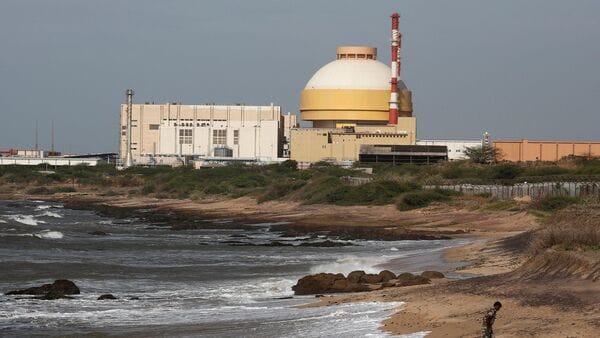
New Delhi: State-run NTPC Ltd has proposed developing six nuclear reactors in collaboration with Russian state-owned Rosatom at an estimated capital expenditure of ₹1.5 trillion, two people in the know said. The proposed units are part of an agreement signed between India and Russia in 2014 to build 12 nuclear reactors in the country. Under that agreement, state-run Nuclear Power Corp. of India Ltd () has been working on six units (two of which are already operational) alongside Rosatom at its Kudankulam plant, but the remaining six are yet to take off.
“The government can allocate us the six units as it is a government-to-government agreement. We have suggested that the remaining six units be allocated to NTPC,” said one of the two people cited above.
NTPC has offered to deploy Rosatom’s VVER 1000 reactors across the six remaining units, each with a capacity of 1,000 MW. Industry estimates place the cost of nuclear capacity at ₹25 crore per megawatt, bringing the total cost for the planned 6,000 MW (6GW) project to ₹1.5 trillion.
In response to Mint’s emailed queries, an NPCIL spokesperson said, “NPCIL is presently implementing 1,000MW capacity PWRs/VVERs in collaboration with the Russian Federation at Kudankulam, Tamil Nadu. Of the six units planned at Kudankulam, two are already operating while the remaining four are under various stages of construction. On completion of these under construction units, the installed capacity of the site would reach 6000 MW.”
“The information sought with respect to NTPC Ltd may be obtained from them. NPCIL has no inputs in this regard,” the spokesperson added.
Queries mailed to NTPC, Rosatom, the department of atomic energy, the ministry of power and the Russian embassy in New Delhi on Wednesday remained unanswered at the time of publishing.
NTPC, which aims to reach 30GW of nuclear capacity by 2047, has identified three sites in Madhya Pradesh, Bihar, and Odisha to build 2-4GW at each location, a third official said on condition of anonymity. Detailed feasibility reports for these sites have been submitted to the Atomic Energy Commission for approval. Although nuclear power is non-renewable, it is considered a clean, non-fossil fuel source that can supply baseload power and ensure grid stability as coal-based power generation declines.
Beyond these standalone sites, ’s nuclear power subsidiaries Anu Shakti Vidyut Nigam Ltd and NTPC Parmanu Urja Nigam Ltd plan to set up 30GW generation capacity, with Anu Shakti Vidyut Nigam Ltd (a joint venture of NTPC and NPCIL) setting up 2.8 GW at the Mahi Banswara project in Rajasthan. NPCIL, operating under the Department of Atomic Energy, has been India’s sole nuclear power generator since its founding in 1987, currently running 24 reactors with a combined capacity of 8.78GW.
Another person said, “Indian companies need technology partnerships with global players for which the partners need to come through tenders. Global nuclear power entities, although interested in investing in India post the Shanti Act, are not very keen on coming in through the tender route.” State-to-state agreements remain the only viable path for bilateral partnerships, as seen in the existing pact with Russia for Rosatom, making it a smoother route for NTPC, this person added. The Shanti Act allows foreign and private firms to enter India’s nuclear power sector to support its ambitious energy-transition goals.
NTPC is also in discussions with other international firms for potential partnerships, but those vendors would have to participate through a competitive bidding process, this person said. In April, NTPC signed a memorandum of understanding (MoU) with French energy major EDF for nuclear power technology.
Responding to a question in the Lok Sabha in August, Jitendra Singh, minister of state for personnel, public grievances & pensions and the Prime Minister’s Office, who also handles the department of atomic energy portfolio, said India’s long-term nuclear energy strategy continues to be guided by the country’s three-stage nuclear power programme, aimed at sustainable utilization of its vast thorium reserves for long-term energy security.
“The government has adopted a two-pronged approach to accelerate nuclear capacity addition. This includes deployment of large indigenous reactors such as 700 MWe pressurised heavy water reactors (PHWRs) and advanced reactor designs at greenfield sites, alongside development and deployment of small modular reactors (SMRs) at brownfield locations, including retiring fossil-fuel-based power plants, captive plants for energy-intensive industries and off-grid applications in remote areas,” he said.
He noted that the reforms under the Shanti Act envisage greater participation of private entities in nuclear manufacturing, engineering services, research and development and supply chains, while maintaining stringent standards of nuclear safety, security and safeguards.