



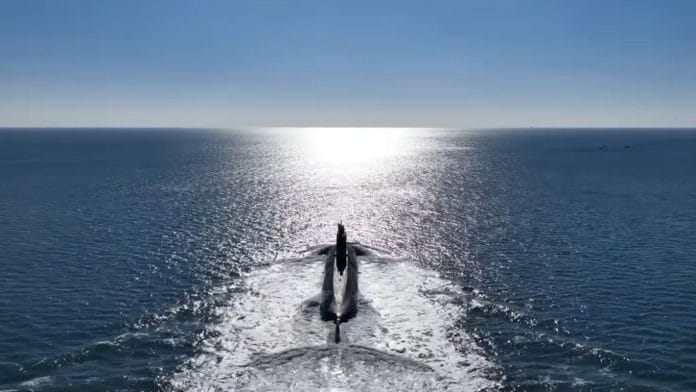
The video a convergence of three layers of meaning:
One of the most of the video is its deliberate use of nomenclature. The names of characters—Liao Ning, Shan Dong, and Fu Jian—correspond to aircraft carriers in the PLAN.
More analytically significant is the introduction of the fourth character, He Jian, a 19-year-old recruit. His name combines a common surname, ‘He’, with the character 舰 (warship), producing a genericised naval designation rather than a specific platform reference. It’s a , one that signals a futuristic naval identity without anchoring it to a clearly identifiable asset class.
In this sense, the character of He Jian works as a conceptual placeholder. Its ambiguity appears intentional, preserving interpretive openness and generating anticipatory meaning. This has led to speculation in that it may allude to a future platform, associated with the hypothesised next-generation and more powerful Type 004 aircraft carrier.
This logic is reinforced by the within the video. The age assigned to He Jian, 19, maps onto the hull-number progression of China’s aircraft carriers: Liaoning (16), Shandong (17), and Fujian (18). The combination of numerical sequencing, institutional hierarchy, and generational succession creates a system of tightly ordered symbols.
The intergenerational dialogue further deepens this interpretive structure. In the video, Liao Ning says to Shan Dong, “The new generation succeeds the old, and your generation is better than mine.” This affirms institutional continuity, encoding a doctrine of technological succession, where each new generation of platforms supersedes an earlier iteration in capability and sophistication.
What distinguishes Into the Deep from earlier PLA media outputs is . Traditional Chinese military messaging has typically oscillated between formal disclosure and controlled opacity—meaning is either explicitly stated or deliberately withheld. This video, by contrast, operates through ‘orchestrated ambiguity’: it neither confirms nor conceals, but instead opens a space for interpretation while leaving conclusions open-ended and adding an element of deniability. The result is a shift from strict flow and restriction of information to a state-defined, controlled narrative.
The effectiveness of this approach lies in its fusion of platforms with people. Additionally, the video reflects a broader discourse of naval modernisation, shifting from mechanised expansion to fully networked, ocean-capable carrier formations. As one commentary , this marks a move from quantitative buildup to qualitative transformation, with capability built step by step, through real equipment and joint combat capability across theaters. New-generation fighters, anti-ship missiles, and support systems are thus presented as operational assets intended for real combat conditions.
As Guancha columnist Cheng Liang , this shift is most evident in carrier development centred on the Fujian and future platforms. Electromagnetic catapults enable heavier aircraft, longer-range operations, and more diverse air wings, including airborne early warning aircraft and unmanned systems. Alongside this is growing integration of carrier-based drones, with reports of stealth unmanned platforms indicating emerging manned-unmanned teaming. In such configurations, drones support reconnaissance, electronic warfare, and potentially strike missions alongside fighters such as the J-35 and J-15T.
, a commentator with Southern Press Media Group and a researcher at the Academy of Military Sciences, argues that the PLAN video should be understood as an expression of the leapfrog development of China’s aircraft carrier programme. In Pan’s reading, the video’s layered symbolism frames the PLAN’s shift toward deep blue capabilities as both a technological trajectory and a wider strategic evolution.
A key marker in this developmental arc, according to Pan, is the of a nuclear-powered aircraft carrier, which he identifies as a potential inflexion point in China’s carrier capability. Beyond propulsion, nuclear power would provide effectively unlimited endurance, enable sustained global deployment, and support energy-intensive systems such as electromagnetic catapults.
Pan also notes that nuclear-powered aircraft carriers would extend operational reach beyond the first and second island chains, enabling longer-duration deployments. It would also yield a more complete carrier air wing, including stealth fighters, airborne early warning aircraft, and aerial refuelling platforms, together signalling a transition toward full-spectrum blue-water capability.
The video’s concluding easter egg scene adds yet another . It shows submarine captain Shan Dong picking up his son Xiaowan at Tongtong Road Primary School in Weihai. ‘Xiaowan’, meaning little Wan, is a clear play on Taiwan. In this context, the sequence is a subtle reference to national unity and an emotional framing of Taiwan’s return to China by PLAN.
Into the Deep demonstrates the increasing sophistication of China’s military communication strategy, in which capability signalling, ideological narrative, and symbolic ambiguity are tightly interwoven. Rather than functioning as conventional propaganda, the video operates as a device for interpretation, subtly shaping expectations about future developments in China’s naval trajectory. In doing so, it gestures toward what may come next without explicit confirmation, guiding how domestic audiences are encouraged to read naval modernisation.
The video seems to have met its objective. It has generated considerable domestic attention, with a strong sense of enthusiasm and expectation regarding the pace and direction of China’s naval development.
Sana Hashmi, PhD, is a fellow at the Taiwan-Asia Exchange Foundation. She tweets @sanahashmi1. Views are personal.
(Edited by Prasanna Bachchhav)

