


The Commission for Air Quality Management (CAQM) has modified the Graded Response Action Plan (GRAP) framework for Delhi-NCR, with changes affecting vehicles, construction activity and the implementation of pollution-control measures.
The revised government framework, announced on September 29, 2026, divides into four stages based on Delhi’s air quality. The measures under successive stages are cumulative. This means that a restriction under Stage I will continue under Stage II and so on.
Restrictions on BS-III petrol and or below-standard light motor vehicles (LMVs) under GRAP Stage III have been extended to Sonipat apart from Gurugram, Faridabad, Ghaziabad and Gautam Buddha Nagar. Now vehicles from three Haryana and two Uttar Pradesh districts will be under restrictions.
So, here’s what the new GRAP framework means for your vehicle if you are from these places.
While restrictions under the old rules have been retained, certain new vehicle-related restrictions have been made added.
Under the new framework, restrictions on certain inter-city and inter-state buses have been brought under GRAP Stage I, instead of Stage II. Buses from Haryana, Uttar Pradesh, Rajasthan and adjoining states, including Punjab, Himachal Pradesh, Madhya Pradesh, Uttarakhand and Jammu and Kashmir, will not be permitted to ply in Delhi-NCR unless they are EV, CNG or BS-VI diesel buses, according to the new changes.
Another major change is the extension of CAQM’s directions on construction and demolition activities to a wider set of areas, including urban, controlled and development areas, industrial areas and zones, and highway corridor zones in NCR states.
The has also removed the earlier exemption for BS-IV and below goods vehicles carrying essential commodities under GRAP Stages III and IV.
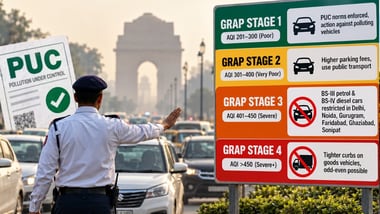
The revised government document classifies GRAP into four stages:
According to the framework announced by CAQM, measures under various stages of GRAP can be taken in advance if forecasts indicate that an AQI threshold is likely to be reached. If pollution unexpectedly crosses a threshold because of extreme meteorological or other episodic conditions, the corresponding measures can be imposed immediately.
Whether a private car can ply in the region depends on the GRAP stage, fuel type, BS emission standard, vehicle category and location. There is no blanket ban on all private cars throughout Delhi-NCR under the framework.
At Stage I, authorities will be ordered to strictly enforce PUC norms for the vehicles. Vehicles flouting the norms or those visibly polluting can be impounded and/or face penalty.
During the Stage I framework restrictions on the entry of certain inter-city and inter-state buses into Delhi-NCR, although EV, CNG and BS-VI diesel buses are permitted.
The revised framework does not prescribe a blanket ban on private cars under Stage II, instead, it calls for a higher parking fees to discourage private transport and encourages the use of public transport.
At this stage, certain vehicles face restrictions. Under Stage III, NCR states and the Delhi government will have to impose strict restrictions on BS-III petrol and BS-IV diesel LMVs (four-wheelers) and lower-standard vehicles.
The restriction covers Gurugram, Faridabad and Sonipat districts of Haryana, Ghaziabad and Gautam Buddha Nagar from Uttar Pradesh apart from Delhi.
Noida, which falls within Gautam Buddha Nagar district, will also face restrictions in this stage.
Stage IV further tightens the restrictions on goods vehicles but does not recommend for the introduction of blanket ban on all private cars.
In this stage no heavy goods vehicle (HGV) other than LNG, CNG, electric and BS-VI diesel trucks can enter the national capital. Delhi-registered diesel BS-IV and below HGVs are also prohibited from plying in Delhi.
After Stage III of GRAP comes into effect, BS-III petrol LMVs and BS-IV diesel LMVs face restrictions in Delhi and the specified high-vehicle-density NCR districts.
Outside-Delhi registered diesel BS-IV and below light goods vehicles are also not permitted to enter Delhi under the Stage III provisions.
Yes. The Stage III provision specifically allows persons with disabilities to ply BS-III petrol/BS-IV diesel LMVs where the vehicles have been specifically adapted for their personal use.
For heavy goods vehicles under Stage IV, LNG, CNG, electric and BS-VI diesel trucks are exempted from the general restriction on entry into Delhi.
Earlier exemption for BS-IV and below goods vehicles carrying essential commodities under Stages III and IV has also been removed.
Not automatically, but the revised framework says that under Stage IV, state governments may consider additional emergency measures, including allowing vehicles to run on an odd-even basis according to registration numbers.
So, the invocation of Stage IV itself does not mean an odd-even scheme automatically comes into force.