



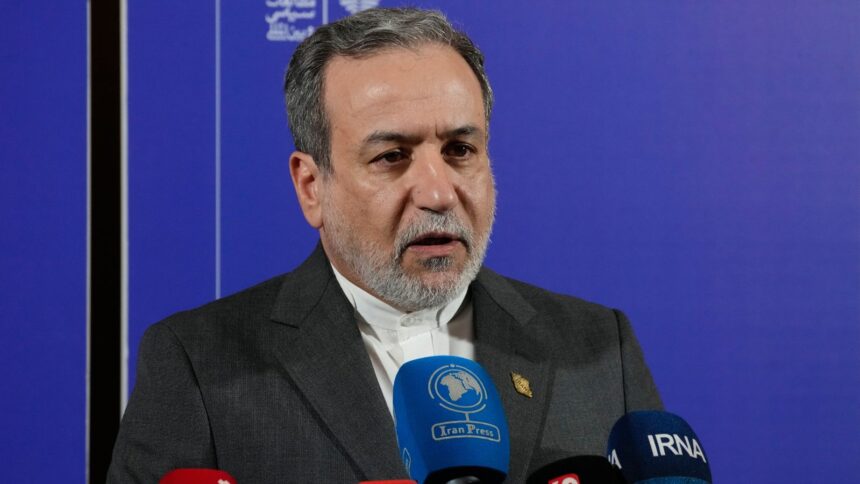
Iranian Foreign Minister Seyed Abbas Araghchi on Saturday said Tehran has “never refused to go to Islamabad” for peace talks, while stressing that any negotiations must lead to a “conclusive and lasting” end to the ongoing conflict.
“We are deeply grateful to Pakistan for its efforts and have never refused to go to Islamabad,” Araghchi said in a social media post.
“What we care about are the terms of a conclusive and lasting END to the ,” he added.
Also Read |
His remarks came amid speculation about a possible deadlock in Pakistan-facilitated talks between Iran and the United States, which Islamabad has been trying to mediate since the conflict escalated.
According to news agency PTI, Pakistan on Saturday rejected media reports suggesting its peace initiative had stalled after an initial exchange of proposals.
Foreign Office spokesperson Tahir Andrabi dismissed the reports as “baseless” and a “figment of imagination”.
“We have noted several reports in the media, including on social media, citing so-called official government sources regarding the ongoing conflict in the region and Pakistan’s efforts to promote peace and dialogue,” he said in a statement.
“We categorically reject these false insinuations attributed to purported official sources as baseless and a figment of imagination. Any attribution to official sources in this regard is incorrect,” Andrabi added.
He also said that a briefing held at the Ministry of Foreign Affairs had been “misrepresented” and urged media outlets to rely on official statements.
“We therefore urge all media platforms to exercise due diligence, avoid speculation and rely exclusively on officially issued statements and media readouts for accurate and timely information,” he said.
Pakistan had stepped in after the conflict expanded across the Gulf region, with Islamabad attempting to facilitate talks between Washington and Tehran.
Quoting an unnamed official, Pakistan’s Dawn newspaper reported that some progress had been made, with messages relayed between the two sides, but momentum slowed due to the absence of a clear Iranian signal.
“It is surprising that despite the obliteration of significant naval, air force, and other military and civilian infrastructure, Iran has not responded positively to calls for negotiations,” the official was quoted as saying.
The official added that , but Tehran had not formally conveyed readiness.
Pakistani leaders, however, remained in contact with Iranian President Masoud Pezeshkian and Foreign Minister Araghchi, the report said.
Araghchi reiterated Iran’s willingness to restart talks in Pakistan, while insisting that Tehran seeks a “conclusive and lasting” end to the conflict, the Associated Press reported.
Pakistan had earlier said it was ready to host talks between the US and Iran, though the timeline remains unclear.
The conflict escalated after the US and Israel jointly attacked Iran on February 28, and several top commanders.
Iran’s retaliation widened the war across the Gulf region, disrupting global energy supply chains and affecting shipping through the
Despite the escalation, Pakistan has attempted to position itself as a mediator while avoiding direct involvement in the conflict.
(With inputs from PTI, AP)

