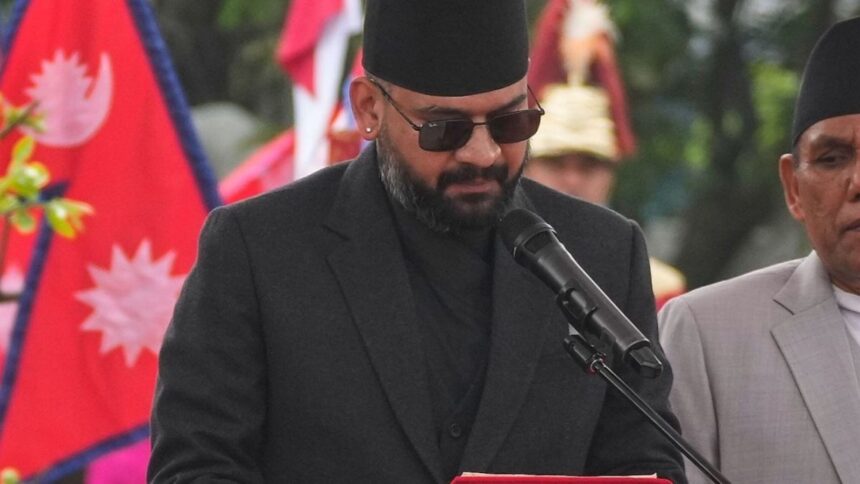
on Sunday said he had recently learnt that Nepal may also be “encroaching” or occupying certain areas claimed by India, even as he reiterated Kathmandu’s position that India has encroached on Nepalese territory in the long-running border dispute between the two neighbours.
Addressing Nepal’s parliament, Shah said both countries had agreed to work towards resolving the issue through diplomatic channels with the assistance of historians, surveyors and other experts. He added that Nepal had also held discussions on the matter with China and the United Kingdom.
Nepal and India have a longstanding dispute over the Kalapani, Lipulekh and Limpiyadhura regions, which both sides claim. India maintains that the areas fall within Uttarakhand and has consistently said that the issue should be settled through bilateral dialogue.
“The Nepal government has formally sent a diplomatic note to India regarding what we see as encroachment of Nepalese territory, including Lipulekh, and we have received a response,” Shah told lawmakers. “Both sides have agreed to address the matter through dialogue, with support from historians, surveyors and relevant experts”, he added.
Shah, however, suggested that the issue was not one-sided.
“What surprised me after becoming Prime Minister is that it is not only India that is accused of encroaching Nepalese land. In some places, Nepal may also be occupying territory claimed by India,” he said, adding, “Both countries should examine the facts objectively and resolve the matter amicably as friends.”
He said Nepal had also raised the issue with China, given that the disputed areas lie close to the India-Nepal-Tibet trijunction, and with the United Kingdom because the origins of the boundary dispute date back to the colonial era.
The remarks sparked debate in Nepal, with several political observers and former diplomats questioning the Prime Minister’s assertion.
Former Nepal ambassador to India Nilambara Acharya told Kantipur that there was no official information suggesting Nepal had encroached on Indian territory. He noted that about 97 per cent of the India-Nepal boundary issues had already been settled, with only a few disputes remaining unresolved.
Acharya said instances of Nepalese and Indian citizens cultivating land across the border due to missing or damaged boundary pillars should not be interpreted as state encroachment.
Another former envoy to India, Deep Kumar Upadhyay, said there was no record of Nepal occupying Indian territory and that India had never formally raised such a complaint.
Border expert and geographer Buddhi Narayan Shrestha also rejected the claim, saying Nepal had never extended its control into Indian territory, though cross-border farming arrangements existed in some areas.
Earlier this month, Nepal’s Foreign Ministry reiterated its commitment to resolving the boundary issue through diplomatic means. The statement came after India rejected Nepal’s objection to the Kailash Mansarovar Yatra route through Lipulekh Pass, describing Kathmandu’s territorial claim as an “unilateral artificial enlargement” that New considers untenable.