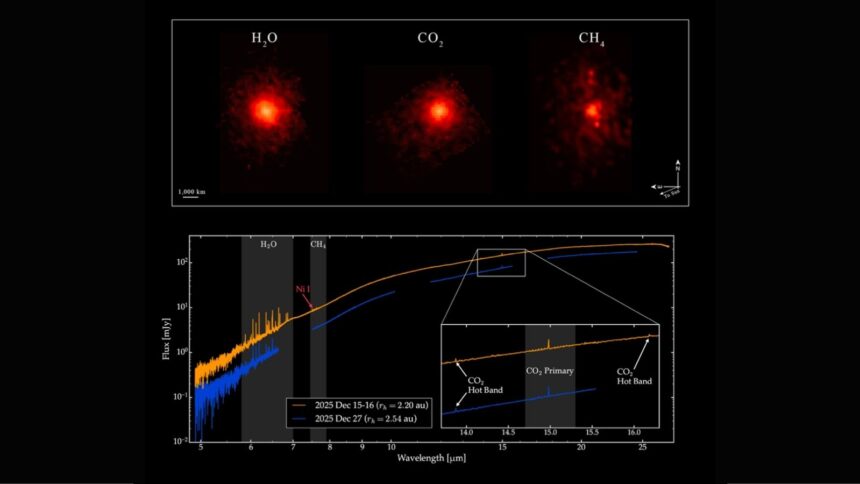
Nasa’s James Webb Space Telescope has detected methane on the interstellar comet 3I/ATLAS, marking the first direct detection of the gas on an object that originated outside our solar system.
The findings, recently published in The Astrophysical Journal Letters, are based on observations made using Webb’s Mid-Infrared Instrument (MIRI) as the comet travelled away from the Sun after its closest approach.
Webb observed the comet on two occasions: December 15–16, when 3I/ATLAS was about 329 million kilometres from the Sun, and again on December 27, when it was approximately 379 million kilometres away.
Scientists found that methane appeared only after the comet had passed near the Sun. Because methane is highly volatile and readily transitions from ice to gas, researchers believe it was buried beneath the comet’s surface and remained protected until solar heating reached deeper layers of ice.
The amount of methane detected relative to water was unusually high compared with most known comets in the solar system. Webb also confirmed that 3I/ATLAS contains large amounts of carbon dioxide and releases significantly more carbon dioxide relative to water than typical solar system comets.
According to , these chemical characteristics suggest that the comet formed in an environment very different from the one that produced most comets in our solar system.
The observations also revealed that gas production declined as the comet moved farther away from the Sun. Water emissions showed the steepest drop, which researchers say is expected because ice requires more heat to vaporise than methane or carbon dioxide.
The data were collected using MIRI’s Medium Resolution Spectrometer, which separates infrared light into different wavelengths. The instrument allowed scientists to identify gases surrounding the comet and map how those materials were distributed around its nucleus.
The discovery opens up new perspectives on the composition of interstellar objects and offers a rare opportunity to study material formed around another star system.