



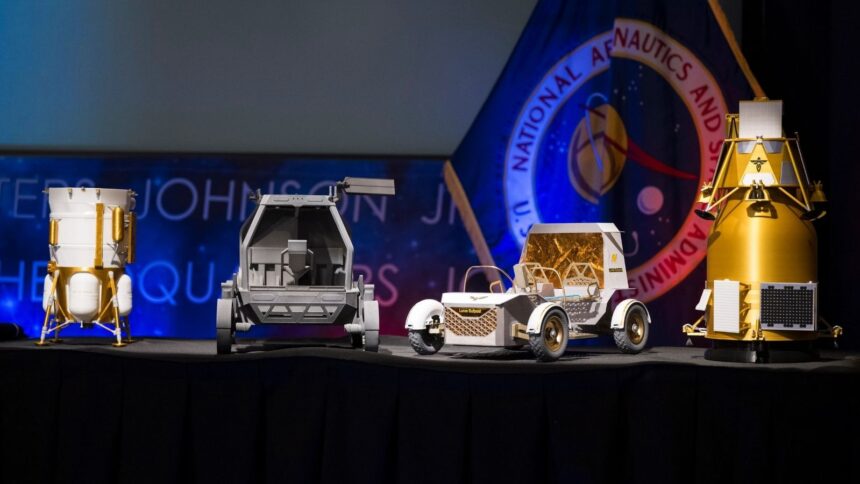
Nasa has unveiled new details about its Moon Base programme, outlining a series of robotic lunar missions, rover contracts, and infrastructure plans to support a long-term human presence near the Moon’s South Pole ahead of future Artemis astronaut landings.
During a Moon Base event held at headquarters in Washington on May 26, the American space agency announced multiple lunar exploration milestones, including new contracts for crewed and autonomous rovers, upcoming cargo lander missions, and technology demonstrations expected to begin as early as later this year.
Nasa Administrator Jared Isaacman described the Moon Base initiative as humanity’s first permanent outpost on another celestial body, adding that every mission will help prepare astronauts for future deep-space exploration and eventual missions to Mars.
The agency confirmed the first three Moon Base missions currently in development.
Moon Base I, targeted for launch no earlier than fall 2026, will use Blue Origin’s Blue Origin’s Blue Moon Mark 1 Endurance lander to deliver scientific instruments and technology payloads to the Shackleton Connecting Ridge region near the lunar South Pole. The mission will study how rocket thrusters interact with lunar dust and terrain, while also testing navigation systems for future crewed Artemis landings planned for 2028.
Moon Base II, scheduled for launch later this year, will send more than 1,100 pounds of cargo aboard Astrobotic’s Griffin lander. The mission will carry Astrolab’s FLIP rover to help test mobility systems for future lunar terrain vehicles.
Moon Base III will use Intuitive Machines’ Nova-C Trinity lander to deliver the Lunar Vertex investigation, which will study mysterious lunar swirls — bright surface patterns believed to be linked to magnetic fields and solar radiation interactions. The mission will also include payloads from the European Space Agency and the Korea Astronomy and Space Science Institute.
Nasa also announced new contracts for future lunar rovers. The agency awarded approximately $219 million to Astrolab and $220 million to Lunar Outpost to build the first phase of lunar terrain vehicles (LTVs).
Astrolab’s CLV-1 rover, based on its FLEX architecture, is designed to transport astronauts, carry cargo, and support remote lunar operations. Meanwhile, Lunar Outpost’s Pegasus rover is designed for autonomous, teleoperated, and crew-assisted driving with speeds exceeding 9 mph.
To support rover delivery missions, Nasa awarded Blue Origin an additional $188 million task order, with an optional extension valued at more than $280 million.
The agency also provided updates on MoonFall, a robotic mission under development at Nasa’s Jet Propulsion Laboratory. Scheduled for launch in 2028, the mission will deploy four hopping drones designed to explore difficult terrain around the lunar South Pole and identify potential Artemis landing sites. Firefly Aerospace has been selected to build the spacecraft that will transport the drones to the Moon.
Nasa said additional Moon Base missions, technology demonstrations, and cargo contracts will be announced in the coming months under its Commercial Lunar Payload Services (CLPS) programme.
The broader Moon Base effort is part of Nasa’s long-term Artemis strategy aimed at building sustainable lunar infrastructure, expanding commercial partnerships, and eventually preparing astronauts for future crewed missions to Mars.

