



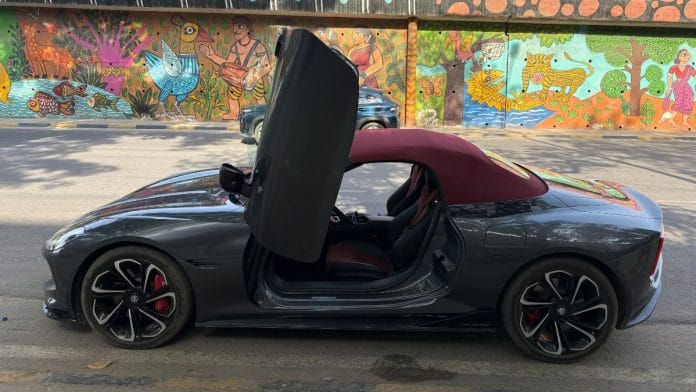
By the way, let me explain why I used ‘whoosh’ here. Because that is my biggest single problem with electric ‘performance’ cars — there is no drama. I don’t know about you, but a performance car is about the noise, the smell of a hot clutch and rubber. And this is something that an electric doesn’t offer.
And how can I miss the piped noise that is sent inside the cabin? That just sounds wrong, in most cases. The MG Cyberster offers you the option of two sounds, an electroinduction sound seemingly copied from the original Tron movie and the sound of a ‘EV’ sportscar. Heck, even the Mahindra XEV 9S I am driving right now has a ‘V8 Tribute’ noise piped through the internal (and external) speakers — this is also offered on the BE6 and XEV 9e.
The irony of electric vehicles offering such sounds is not lost on me. The only time I have seen a decent implementation was on the Hyundai IONIQ 5 N, the performance variant of the IONIQ 5 that I drove in Korea a couple of years ago. But that sound of a turbocharged two-litre Hyundai petrol was integrated with the paddle shifters. You hit the redline and the vehicle would make all the right spitting noises and gurgles.
Yeah, it was a gimmick, but at least a well-done gimmick. And as amazing as vehicles like the Cyberster are to drive, these piped noises don’t do them any justice. It’s doubly true on something like the BMW i5 M60, which, again, is an utterly bonkers electric car in terms of performance. But when you know that you’re not driving a fire-breathing BMW M5, those noises feel wrong.
Because the noise alone cannot create drama, it’s also the vibrations you get through the pedals, the harmonics you feel through the seat. Those add to the experience. So when I drive electrics, I always switch off the fake sounds. But I must admit, when you give an electric the ‘full beans’, as one would say, it is unnerving. Because all you hear is that whoosh of the airflow around the vehicle. With the sole exception of the Hyundai I mentioned earlier, there is no sense of how fast you’re going. Because when you have been driving for a while, and I’m sure some of you feel the same, you get an idea of how fast you are going from the engine noise, even on an automatic.
Yes, electric vehicles have made performance easily accessible for car buyers. The QWD variant of the Tata Harrier EV with dual motor gets you 390 horsepower for under Rs 30 lakh. The Mahindra BE6 with a powerful 280-horsepower motor costs under Rs 25 lakh on-road. I remember when I was in college, the 100-horsepower Honda City would set you back Rs 12 lakh in 2000, which was a lot of money back then.
Electric vehicles have democratised performance, and no ICE vehicle comes close to them. The BMW Z4, which one could consider as the closest competitor to the MG Cyberster is priced almost Rs 25 lakh more on-road. And while it has the BMW badge, the electric MG costs a fifth of the Beamer to run, and that is before the inevitable price hike for petrol.
And here is the thing, electric vehicles are also easier to engineer — no need for complex timing belts and mechanical components. Arguably, because of the huge and heavy battery pack between the wheels, EVs handle better, and the Mercedes-Benz CLA I drove recently is proof of that.
I’ll be honest here. While I do not yearn for the ‘good, old times’, I think modern cars are easier, more accessible, and more reliable than ever before. I also believe that electrification of vehicles is now a fait accompli, and that EVs are efficient, offer sufficient power, and are better for the environment.
But I miss the drama. I miss the sound. I guess I’ll have to live with that reality.

