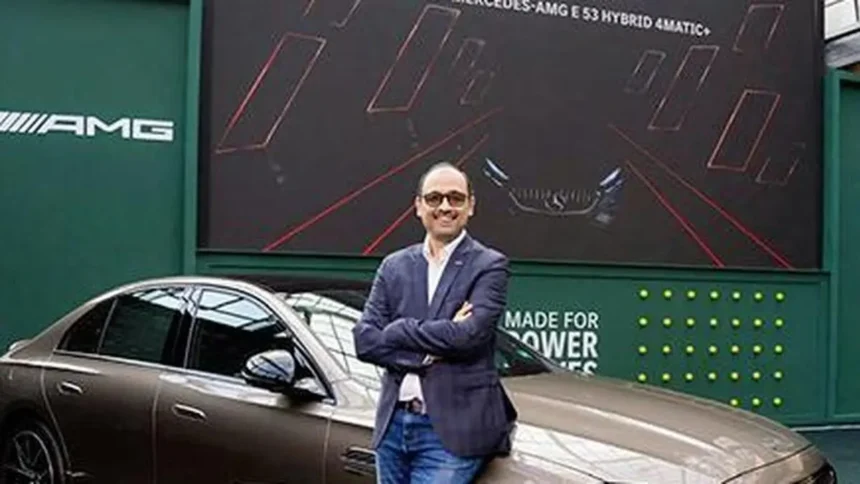
Mercedes-Benz India is investing another ₹200 crore to strengthen manufacturing and localisation capabilities at its Chakan facility near Pune, as bookings for its locally assembled electric GLC cross 1,000 units, with allocations exhausted through March 2027. The expansion comes as the German luxury carmaker seeks to accelerate electric vehicle sales amid BMW’s substantial lead in registrations.
“Our challenge is to get the products to the market,” Santosh Iyer, Managing Director and CEO of Mercedes-Benz India, told businessline, identifying product availability rather than demand as the immediate constraint.
The investment will take Mercedes’ cumulative manufacturing commitment at Chakan to ₹3,200 crore from ₹3,000 crore. Iyer said the company had invested in the electric GLC and its supplier ecosystem, although he did not specify how the additional ₹200 crore would be allocated.
The GLC brings a newer electric platform into local assembly, extending Mercedes’ localisation strategy beyond its higher-priced EQS range.
The investment comes against a competitive challenge. Flash Finance’s compilation of Vahan registrations shows BMW registered 4,134 electric cars during January–October 2026, up 48.9 per cent year on year, against Mercedes’ 1,384, up 9.5 per cent.
Across all powertrains, BMW recorded 17,237 private-car registrations compared with Mercedes’ 16,300. EVs accounted for nearly 24 per cent of BMW’s registrations against 8.5 per cent for Mercedes.
Iyer questioned the comparability of the figures, citing incomplete Telangana updates and changes in reporting methodology. He maintained that company-declared sales provided a more consistent comparison. Mercedes reported 15,190 retail sales during January–September.
Nevertheless, the electric GLC’s advance bookings suggest improving consumer acceptance. Iyer said more than 1,000 customers had booked the SUV without taking a test drive, reflecting a shift in buying behaviour compared with 12–24 months earlier. The electric CLA has also attracted more than 1,000 bookings.
“The moment we opened our bookings, we were sold out for this year,” Iyer said, adding that GLC allocations were exhausted through March 2027.
The broader luxury market remains resilient despite uneven growth across vehicle segments. Iyer estimated January–October luxury-car market growth at around 10–11 per cent, against approximately 17–18 per cent for the overall passenger-vehicle market.
Mercedes expects single-digit growth in calendar 2026, with Iyer anticipating continued momentum in 2027 as additional models from its global product programme reach India.
Localisation will be central to that expansion. Iyer said higher production volumes would allow Mercedes and its suppliers to increase domestic sourcing while maintaining competitive prices and quality.
He cited the E-Class, where glazing components, including the sunroof and side windows, have been localised. The India team is also exploring sourcing opportunities for Mercedes’ global operations.
“Localisation is not an end point,” Iyer said, explaining that deeper sourcing would follow as the Indian luxury market gained scale.
With a broader portfolio and adequate availability, electric vehicles could account for 20–25 per cent of Mercedes’ business, although petrol, diesel and plug-in hybrids would continue to serve different customer requirements.
For Mercedes, the next test is whether fresh localisation investment and strong advance bookings translate into sustained electric-car deliveries and a narrower gap with BMW.
Published on November 4, 2026