



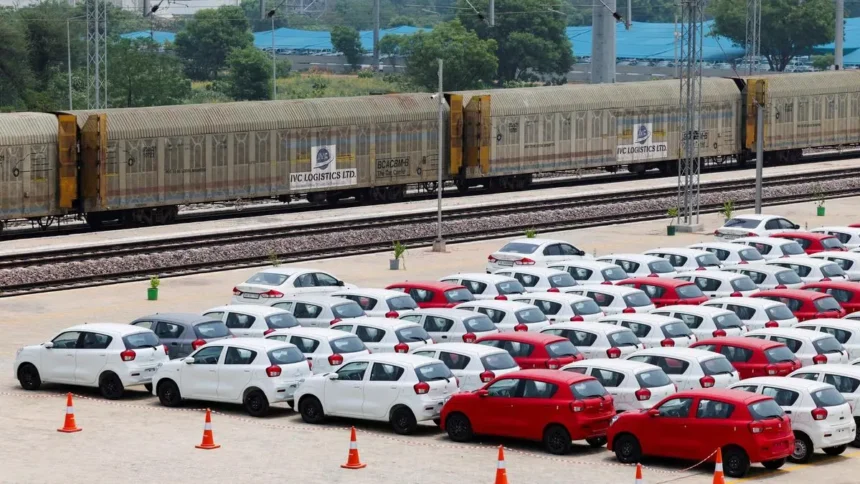
India’s largest passenger vehicles (PVs) maker, Maruti Suzuki India (MSIL) reported a year-on-year (YoY) growth of 37 per cent in its domestic wholesales (dispatches to dealers) to 1,81,838 units in September as compared with 1,32,820 units in the same month last year.
Tata Motors Passenger Vehicles also grew by double digit (15 per cent YoY) in its dispatches to 68,810 units during the month as compared with 59,667 units in the corresponding month last year.
“Looking ahead, we remain optimistic about the festive season, supported by a strong order book and healthy customer traction across the portfolio. As we progressively scale up production, our focus will be on fully leveraging this demand, sustaining our growth momentum and further strengthening our competitive position in the market,” Shailesh Chandra, Managing Director and Chief Executive Officer, Tata Motors Passenger Vehicles, said.
Leading multi-utility vehicles (MUVs) maker, Mahindra & Mahindra (M&M) reported wholesales growth of 14 per cent year-on-year (YoY) to 64,092 units in September in the domestic market, as compared with 58,233 units in the same month last year.
“In September, SUV sales clocked 64,092 units with a growth of 14 per cent, and total vehicle sales stood at 1,14,874, a 15 per cent YoY growth. Adding to this momentum, we are proud to have crossed the milestone of 1-lakh billing of our Electric Origin SUVs since launch,”Velusamy R, President, Automotive Business, M&M, said.
Similarly, Hyundai Motor India (HMIL) reported its monthly domestic wholesales of 57,166 units, up 11 per cent YoY as against 51,547 units in September 2025.
“We are delighted to close September 2026 with our highest-ever total monthly sales of 77,916 units (domestic + exports), registering a healthy double digit growth of 10.8 per cent YoY. This number surpasses our previous record achieved in July 2026,” Tarun Garg, MD & CEO, HMIL said.
Going ahead, the company is expecting sustained customer enthusiasm during the festive season, also supported by the opening of bookings for the Hyundai Bayon, its upcoming all-new nameplate for India, he added.
‘Hector’ maker, JSW MG Motor India also reported a YoY growth of 19 per cent in its domestic wholesales to 8,018 units during the month as compared with 8,018 units in the corresponding month last year.
In the two-wheeler segment, country’s top scooters maker, Honda Motorcycle & Scooter India (HMSI) reported a record growth of 26 per cent YoY to 6,36,768 units in September as compared with 5,05,693 units in the same month last year.
However, Bajaj Auto reported a YoY decline of 12 per cent in its domestic wholesales to 2,39,771 units in September as compared with 2,73,188 units in September 2025.
In the commercial vehicles (CVs) segment, Mahindra’s Truck & Bus division (MTBD) and SML Mahindra Limited (SML) reported a total domestic dispatches of 5,824 units during the month as compared with 3,808 units in September last year, thereby registering a growth of 53 per cent YoY.
“September marked a strong month for the truck and bus segment, helped by early festive buying, continued infrastructure activity and steady freight movement. Growth was further aided by the lower base of the previous year, when buying sentiment was impacted by anticipated regulatory changes,”Vinod Sahay, Executive Chairman – SML, President – Aerospace, Advanced Technologies, Trucks, Buses & CE, M&M, said.
VE Commercial Vehicles (A Volvo Group and Eicher Motors joint venture) recorded sales of 11,396 units in September as compared with 7,619 units in September 2025, a growth of 49.6 per cent YoY.
Force Motors Limited, India’s largest van maker and a leading automotive manufacturer, reported total domestic wholesales of 4,027 units in September 2026, registering a strong 62% growth compared to 2,486 units sold in September 2025.
In the tractor segment, Escorts Kubota reported a YoY decline of 16.2 per cent in its domestic sales to 14,911 units during the month as compared with 17,803 units in the same month last year.
“September 2026 performance is not comparable with the corresponding period last year, given the high base following the GST rate reduction in September 2025, shift in the festive season to October 2026, patchy monsoon conditions and relatively lower Kharif sowing. Looking ahead, festive demand, crop harvesting and improving rural liquidity are expected to support industry volumes. However, the high base effect may continue to moderate industry growth in the near term,” the company said.
Published on October 1, 2026