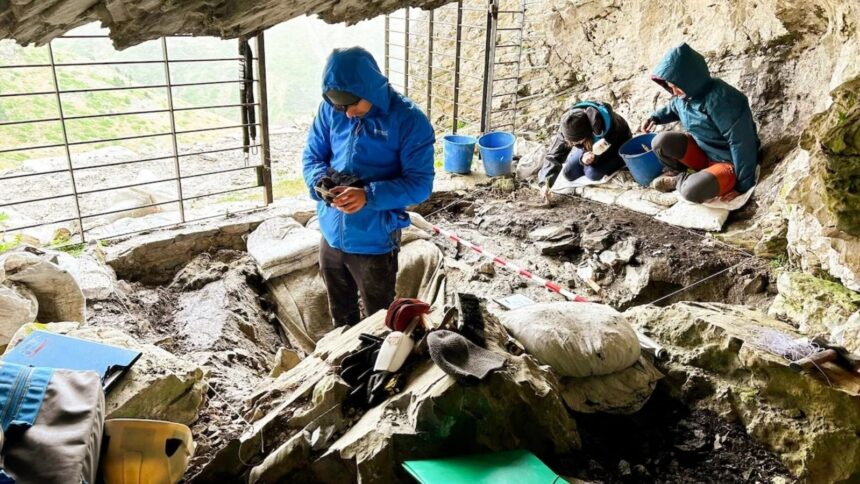
A remarkable archaeological discovery high in the Spanish Pyrenees is reshaping scientists’ understanding of how prehistoric humans lived and used mountain landscapes thousands of years ago.
Researchers have uncovered evidence of a long-term human settlement inside a cave known as Cova 338, located 2,235 metres (7,333 feet) above sea level in the Núria Valley of northeastern Spain. The site is now considered the highest-altitude prehistoric dwelling of its kind discovered in the region.
For decades, archaeologists believed that areas above 2,000 metres were mainly used as temporary routes for travel or seasonal activities. However, findings from Cova 338 suggest that prehistoric communities repeatedly occupied the cave over roughly 5,000 years, from the 5th to the 1st millennium BC.
The excavations, carried out between 2021 and 2023 by researchers from the Universitat Autònoma de Barcelona and the Institut Català de Paleoecologia Humana i Evolució Social (IPHES-CERCA), uncovered a variety of artefacts indicating organised human activity.
Inside the cave, archaeologists found traces of hearths, animal bones, ceramic fragments and personal ornaments, including a pendant made from a marine shell and another crafted from a brown bear tooth.
The discoveries indicate that the cave was more than a temporary shelter. Researchers believe it served as a base for a range of activities carried out by different groups over several millennia.
One of the most intriguing aspects of the site is that occupation appears to have occurred in phases. Archaeological dating suggests periods when the cave was abandoned before being reoccupied, indicating that people may have returned according to planned seasonal or economic cycles.
Among the most significant discoveries was a collection of green minerals believed to be malachite, a copper-rich mineral. Researchers think these materials were brought into the cave for processing, providing some of the earliest evidence of copper extraction and mineral exploitation in Western Europe.
The findings suggest prehistoric communities had a sophisticated understanding of mountain resources and may have developed organised systems for gathering and processing valuable materials.
Also Read:
According to the research team, the discovery challenges the long-held view that high-altitude regions were marginal spaces for ancient populations. Instead, Cova 338 appears to have been an important economic and strategic location integrated into wider prehistoric networks.
The study, published in the journal Frontiers in Environmental Archaeology, highlights how ancient communities adapted to and actively used challenging mountain environments long before modern technology made such landscapes easier to access.
—-