



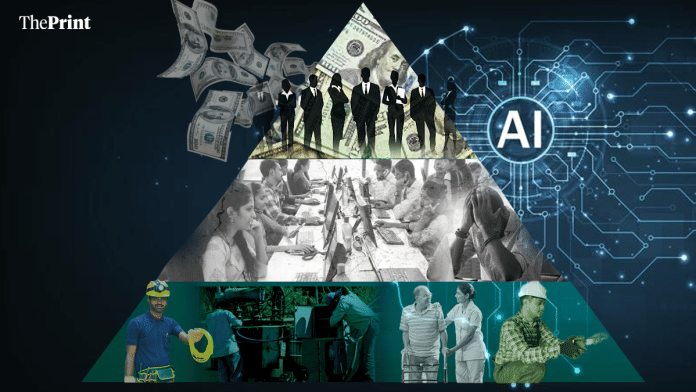
“The more intelligent technology we invent, the more your intelligence matters,” said Chris Pissarides, a Nobel Prize-winning professor of Economics at the London School of Economics (LSE) who has studied the effects of automation on jobs. “When the technology we invented was simpler, your IQ didn’t matter very much. But now it matters more and more with these more advanced technologies.”
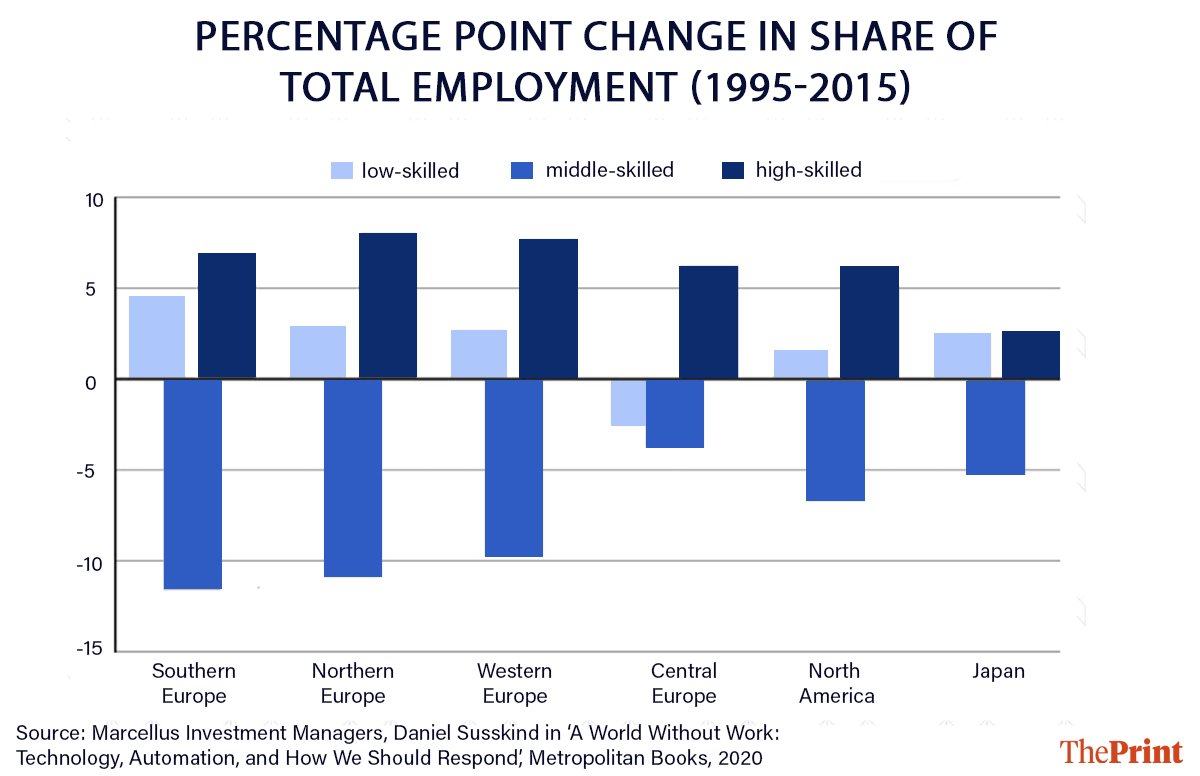
Twenty years before ChatGPT was launched in 2002, American economists David H.Autor, Frank Levy and Richard J. Murnane showed that middle class jobs were being lost in Western economies as automation and robotisation in factories took away the need for the machine supervisors, the mechanics and the clerks.
Their bosses (the CEOs) were increasingly well-paid and less-skilled workers at the bottom of the period, e.g. janitors, labourers, waiters, etc, were also required but those in the middle were increasingly redundant.
Autor, Murnane and Levy dubbed this phenomenon “polarisation” (see chart above).
Post-2022 as AI has spread across every aspect of life and work in the developed economies, it is leading to another round of polarisation; this time the middle class jobs are being lost in the offices rather than in the factories.
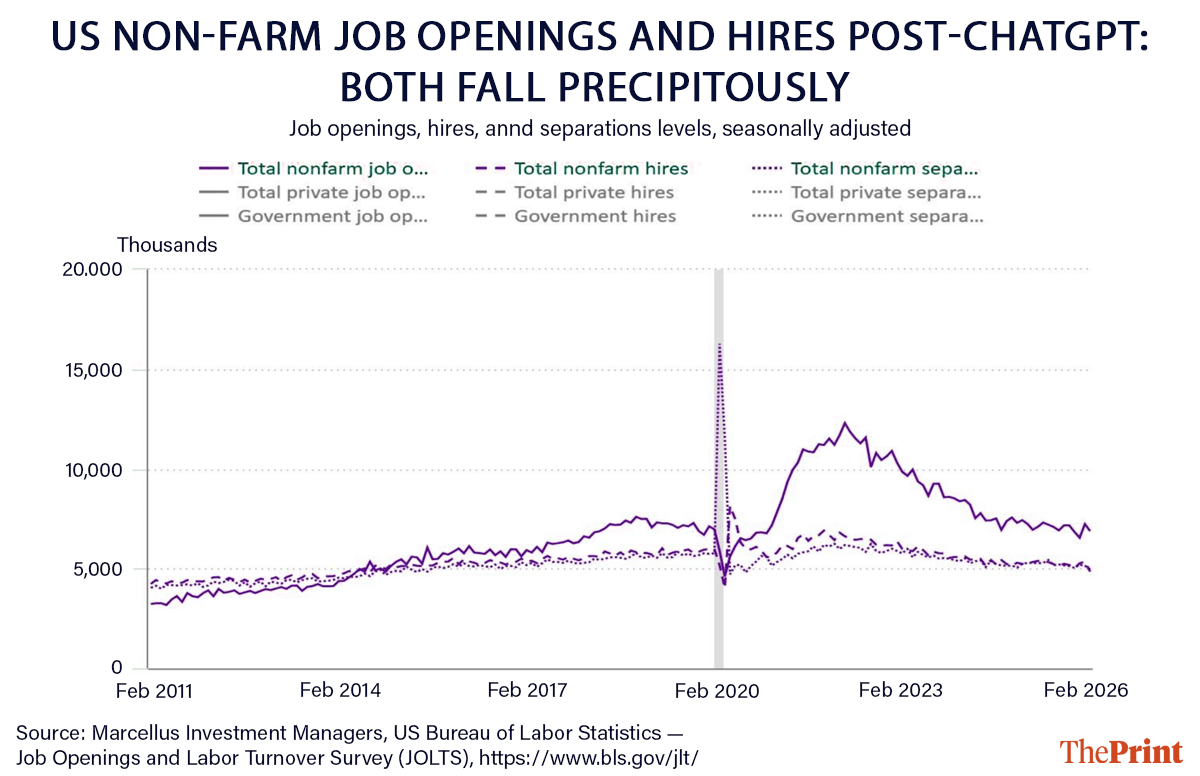
In fact, if US Bureau of Labor Statistics data is considered, the picture becomes quite clear: in 2023 (after ChatGPT’s launch), both the openings and hiring in non-farm jobs fell precipitously (see below).
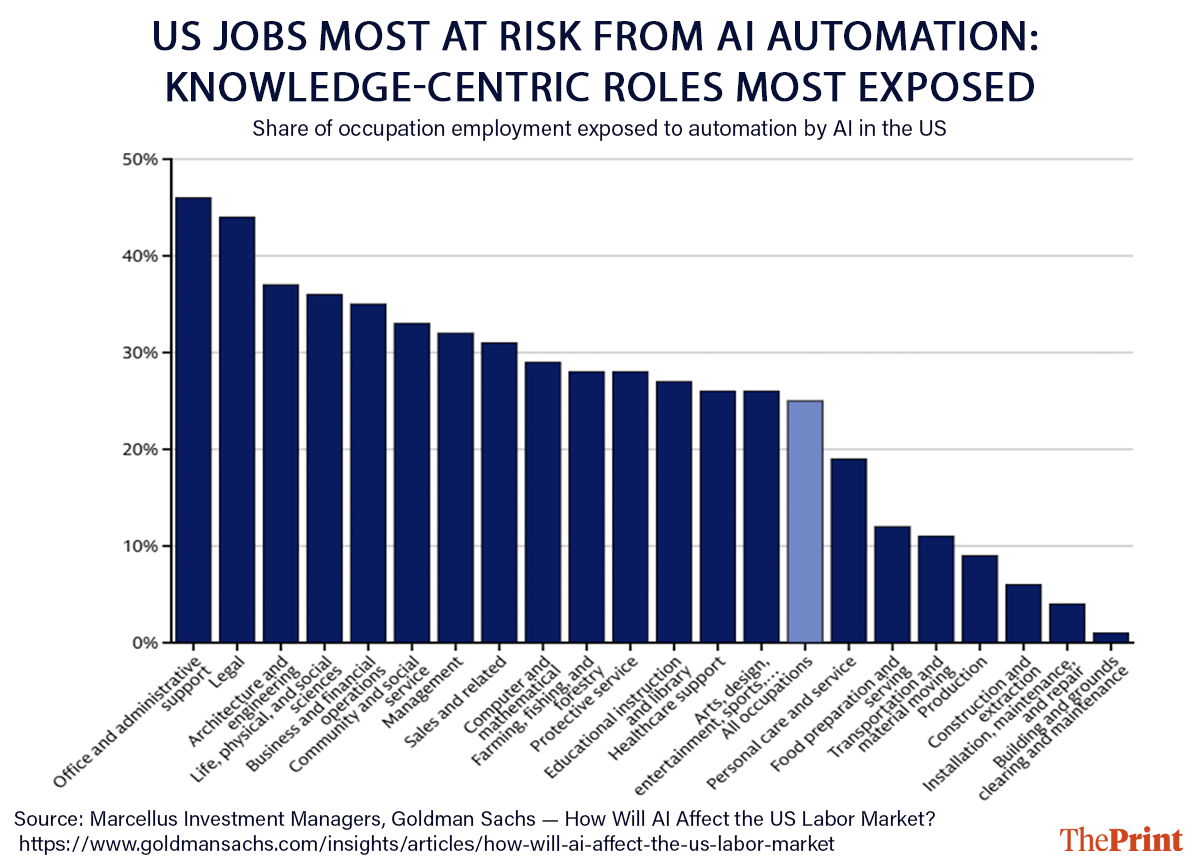
More importantly, Goldman Sachs, in one of their articles, detailed which sectors and jobs are at most risk due to AI rendering their skills useless—and most of these turned out to be knowledge-centric, the bastion of the middle class, whereas those at the lower end of the skill spectrum are less likely to be displaced. All in all, in the US, AI has the potential to automate tasks that account for 25 percent of all work hours.
The discussion on wages is more nuanced than the one on jobs, because here it is not just skill of the employee in question but also their productivity and complementarity of the occupation with AI.
According to the International Monetary Fund (IMF), when complementarity of AI with labour is lower, capital productivity improvement occurs and income inequality reduces as the displacement effect is larger than complementarity gains, affecting the labour negatively.
When there is high complementarity of labour with AI, the share of labour at the upper income spectrum getting negatively impacted reduces (as they augment their work with AI), and simultaneously because those at the lower end see their incomes getting negatively impacted because they don’t enjoy the high complementarity and get displaced due to AI.
This leads to a widening of income inequality where a few at the upper end of the complementarity and income spectrum. When productivity is also considered, however, the gains from AI are enjoyed by everyone across the spectrum although those at the higher end benefit disproportionately more.
In all scenarios, rising AI adoption helps capital deepening and income generated thereof, i.e., for owners of capital AI adoption is a net positive.
Whilst the authors Cazzaniga M. et al did this analysis in the context of a single country seeing these changes within, they also mentioned that this could be true between countries where resource reallocation occurs between two countries, from lesser developed regions to those more technologically advanced and AI-ready. Case in point is the redundancy of call centres in India, to be replaced by automatic bots (powered by American LLMs) answering customer phone calls.
The relationship between AI and labour is profoundly non-linear. Capital owners are the unconditional beneficiaries regardless of the economic cycle. For labour, the outcomes bifurcate sharply. Those with skills that complement AI command a 56 percent wage premium over peers in the same role without AI skill.
The lowest-skilled workers in physical, in-person, dexterous roles are, paradoxically, somewhat insulated: AI cannot yet care for the elderly, rewire a building, or perform surgery. It is the middle-skilled worker—the paralegal, the junior data analyst, the mid-level coder, the customer support agent—who finds their value proposition quietly and relentlessly eroded.
Another way to rationalise what is happening in the West is that the best paid white collar workers are using AI the most to improve their productivity and performance. “An poll of 4,000 workers in the US and UK shows adoption is heavily skewed towards the best paid workers: more than 60 percent use AI daily, compared with just 16 percent of the lower earners.”
Nobel Laureate Daron Acemoglu, who teaches economics at Massachusetts Institute of Technology (MIT), explains what AI is doing to the Western middle class: “The rhetoric out there is that the tools are going to be democratising. But the reality is that…you require a certain degree of education, abstract and quantitative skills, familiarity with computers and coding in order to be using the models… AI is going to increase inequality between labour and capital. That is almost for sure. I would say it is setting us up for a…shitshow.”

