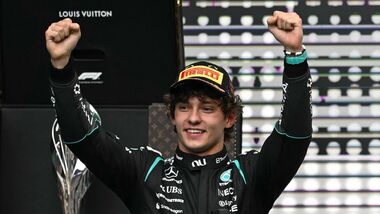
’s climb to Formula 1 World Champion looked almost inevitable once he reached single-seaters, yet the speed that carried him there showed up from the very first tests. In only his second season in , he became the youngest drivers’ champion in the sport’s history, sealing the 2026 title at the Mexico City Grand Prix at 20 years and 68 days old. Most drivers his age are still fighting to leave junior categories; Antonelli had already finished the job.
The Italian spent just three-and-a-half years on the FIA single-seater ladder and did every step of it with PREMA. Until 2026, the Rosin family ran the highly successful junior team, and it was under Rene Rosin that Kimi Antonelli moved from Formula 4 through Formula Regional and straight into Formula 2 before Mercedes handed him a race seat. Rosin has been clear about the first impression: “He was immediately fast.”
That pace arrived early. “In his second F4 race he was fighting for the podium. On the third weekend he got there, at Monza,” Rosin recalled. In the final round of the German F4 series at Hockenheim, PREMA needed one more point to clinch the teams’ title. “I remember the last F4 race in Germany, at Hockenheim. Kimi knew we were one point short of winning the teams’ championship. In the end, he made the overtake on the final lap, on the final corner,” Rosin said.
Speed was only part of the picture. “He has always been very fast, aggressive, determined in taking what he wanted,” Rosin told Corriere della Sera. Wet-weather performance already separated him from the pack. “In the wet, for example, he was already doing things that others struggle to do.” Personality markers appeared just as quickly. “A bright, high-pitched voice and a very high tone. Signs of personality. He already knew where he wanted to get to, and in almost four years with us he proved it,” he added.
Mercedes had passed PREMA “their prodigy,” an Italian teenager everyone already called predestined. The pressure was obvious, yet
kept his feet on the ground. He often arrived at the track with school books. His mother insisted that education travel alongside racing; he completed his high-school diploma while climbing the ranks. On free weekends, he still sought out motorsport, once travelling to watch a PREMA entry at Le Mans.
The same focus that let him memorise previous seasons’ pole times and obsess over details carried him through a shortened junior path. Kimi Antonelli dominated Italian and German F4 in 2022, claimed Formula Regional titles, then jumped straight into FIA Formula 2 with PREMA in 2024, skipping a full Formula 3 campaign. By late 2025, he was a Mercedes race driver. A year later he was world champion, Italy’s first since Alberto Ascari in 1953 and the first graduate of Mercedes’ junior programme to take the title.
Rene Rosin, who left the team with his family earlier this year, watched the Mexico podium knowing the traits had been visible from the start. The early Monza podium, the Hockenheim overtake, the wet-weather edge and the refusal to treat racing as anything less than a full-time craft all pointed the same way. At an age when most drivers are still learning the ladder, Antonelli had already reached the top, and the people who saw the first single-seater runs already understood why.