Tata Motors-owned Jaguar Land Rover (JLR) is preparing for a bigger India expansion, with scope to increase production beyond its estimated annual capacity of 12,000 vehicles at Pune, an electric vehicle portfolio that could grow to four models, and potential opportunities under the India–UK free trade agreement. The strategy comes as JLR begins local assembly of its iconic Defender, cutting prices by as much as ₹34 lakh, or 22.4 per cent, and bringing the luxury SUV back below ₹1 crore six years after its India debut.
The move follows cumulative sales of more than 9,000 Defenders over roughly three-and-a-half years, giving JLR an established customer base as it seeks to translate demand for imported luxury SUVs into higher locally assembled volumes.
Rajan Amba, Managing Director, JLR India, speaking to the media on Tuesday on the sidelines of the launch of the locally assembled Defender, said the company’s Pune manufacturing capacity was expandable, providing scope for higher production as demand grows.
He said JLR had priced the Defender in a manner that “does justice to the brand” while creating “a bit more accessibility” for Indian customers.
Amba cited JLR’s earlier experience with localisation, when demand increased after a luxury model shifted to Indian assembly. However, he did not announce additional production volumes or fresh investment.
The Defender joins the Range Rover and Range Rover Sport in JLR’s locally assembled portfolio, reducing its dependence on imports for some of its popular luxury SUVs.
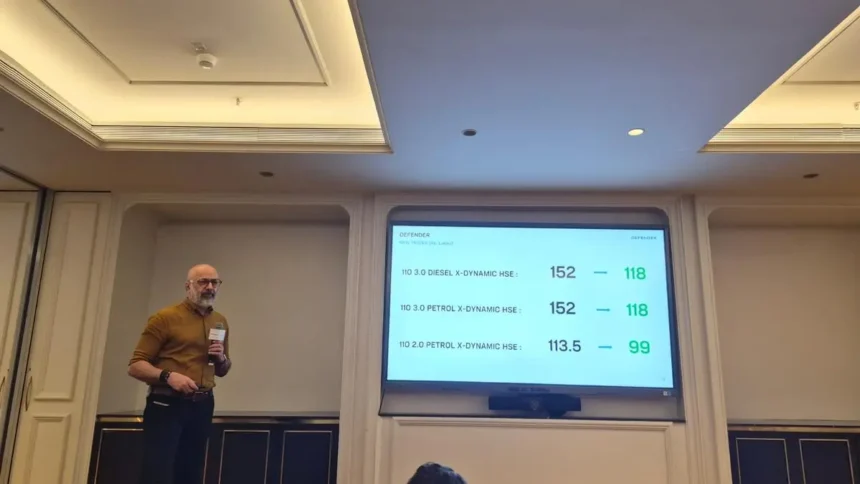
The Defender 110’s 3.0-litre petrol and diesel X-Dynamic HSE variants now cost ₹1.18 crore against ₹1.52 crore for comparably equipped imported versions, a reduction of 22.4 per cent.
The 2.0-litre petrol variant costs ₹99 lakh against ₹1.135 crore earlier, a reduction of 12.8 per cent. The Defender originally entered India in October 2020 at prices starting below ₹80 lakh, before subsequent changes to its model range and pricing.
JLR has also made 29 previously optional features, worth ₹17 lakh, standard on the locally assembled 3.0-litre variants, including electronic air suspension, a head-up display, premium seating and a Meridian surround sound system.
The imported 3.0-litre model’s base price was ₹1.35 crore, rising to ₹1.52 crore with these options. The locally assembled version costs ₹1.18 crore with the equipment included. The 2.0-litre variant gains 17 standard features previously valued at ₹6.5 lakh.
JLR is also preparing to widen its electric vehicle portfolio in India, with Amba indicating that the line-up could eventually comprise four models.
He referred to the upcoming Range Rover Electric, with an India launch indicated around the second quarter of 2027. The company has not confirmed the complete four-model line-up or the import arrangements for these vehicles.
A broader electric portfolio would strengthen JLR’s position against German luxury manufacturers already offering multiple battery-powered models.
The India–UK free trade agreement could eventually improve the economics of importing qualifying British-built luxury vehicles through phased tariff reductions, potentially allowing JLR to introduce more specialised models at competitive prices.
However, Amba cautioned against expecting immediate benefits. “We’ll have to evaluate based on the final details,” he said.
JLR has not identified specific models that would benefit from the agreement.
JLR is strengthening its retail and after-sales infrastructure to support future demand.
“The service is very well-prepared,” Amba said. “All the existing showrooms, we’re expanding where we can.”
For JLR, the challenge is to translate sharper pricing, local manufacturing and a broader product portfolio into sustained growth without diluting the Defender’s premium positioning.
Published on October 27, 2026