



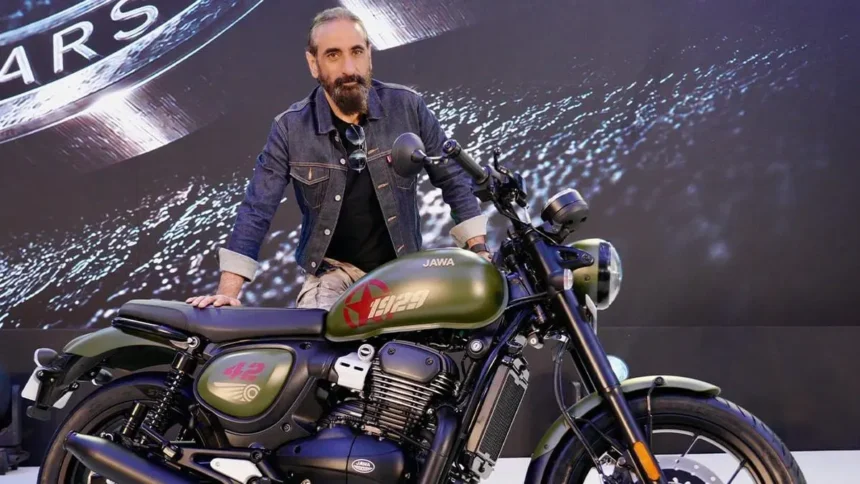
Classic Legends, the Mahindra-backed maker of Jawa, Yezdi and BSA motorcycles, is targeting annual sales of more than 1 lakh motorcycles in FY27, stepping up its product offensive with three Jawa All Stars variants launched within 13 days, even as April-August retail sales rose 54 per cent to 23,098 units. Four new motorcycles, a wider distribution network, and a larger export push are expected to underpin its next phase of growth.
“We have spent the last few years rebuilding the brands, improving the products and strengthening the business. The next phase is about scale. We believe we now have the product portfolio, manufacturing ecosystem, and network to move towards an annual output of more than one lakh motorcycles,” Managing Director and Co-Founder, Anupam Thareja, told businessline.
The high-action rollout began with the All Stars 42 FJ on August 27, followed by the All Stars 42 Bobber on September 4, unveiled by Mahindra Group Chairman Anand Mahindra, and the Jawa All Stars 42 on September 9. The three models are variants or significantly updated iterations of motorcycles already in Jawa’s portfolio rather than entirely new nameplates. Separately, Classic Legends plans to launch up to four new motorcycles during FY27.
The latest 42, which Jawa describes as its most significant evolution yet, features more than 60 enhancements, including new side panels, alloy wheels, wider tyres, and an upswept twin exhaust. The motorcycle is priced from ₹1,79,942 (ex-showroom, Delhi), with deliveries scheduled to begin on September 14.
STRONGER SALES BASE
Classic Legends enters India’s key festive motorcycle-buying season from a considerably stronger position. Retail registrations increased nearly 40 per cent to 45,409 motorcycles in FY26 from 32,482 in FY25, lifting its share of India’s two-wheeler market to 0.21 per cent from 0.17 per cent.
Between April and August FY27, registrations rose 54 per cent to 23,098 motorcycles from 15,000 units a year earlier. Monthly registrations stood at 4,520 in April, 4,447 in May, and 5,334 in June, before easing to 4,541 in July and 4,256 in August. Despite the sequential moderation, July registrations were 84 per cent higher year-on-year, while August registrations grew 61 per cent year-on-year.
The company’s current domestic retail run rate is around 4,600 motorcycles a month, translating into an annualised volume of roughly 55,000 units. While this is significantly higher than FY26 registrations of 45,409 units, it also underscores the scale of growth required to achieve the 1 lakh annual sales target.
500-PLUS TOUCHPOINTS AND A ROYAL ENFIELD CHALLENGE
Distribution is expanding alongside the product portfolio. Jawa Yezdi said its ownership programme is now available across more than 450 sales and service touchpoints nationwide, taking the network closer to the 500-plus touchpoints that Classic Legends is targeting.
Classic Legends is also sharpening the positioning of its three brands. Jawa will focus on modern classics, roadsters, and bobbers; Yezdi on adventure motorcycles, touring, and scramblers; and BSA on larger-displacement premium heritage motorcycles. This places the company across several of Royal Enfield’s strongest segments, although the difference in scale between the two manufacturers remains substantial.
“We don’t want Jawa, Yezdi, and BSA to become three versions of the same motorcycle company. Jawa has its own modern-classic identity, Yezdi has a stronger adventure and scrambler character, and BSA gives us access to the premium heritage space. The engineering can be shared, but the brands have to remain distinct,” Thareja said.
Bridging that gap will require more than domestic growth. Classic Legends is increasingly looking overseas, with BSA expected to play a larger international role and India serving as a manufacturing and sourcing hub for exports to markets, including the UK, Europe, and South America.
“You will see a much faster cadence from us. The All Stars editions are product interventions around motorcycles already in the market, but we also have new motorcycles coming. Our growth will be driven by both product interventions and new nameplates,” Thareja said.
Published on September 9, 2026