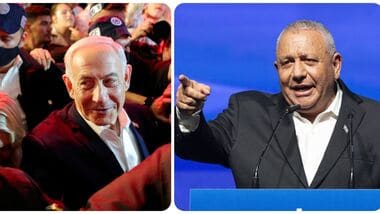
Will Benjamin Netanyahu retain his prime minister’s seat, or will he lose it amid pressure over the Iran and Gaza war? All eyes are on the Israel’s parliamentary elections on Tuesday (October 27), in which about 7.3 million eligible voters will decide Netahyanu’s fate and his grip on power.
Held for the first time since 2022, the elections in Israel are witnessing a tight race between Netanyahu’s Likud party and its right-wing allies, and his top challenger, , the former chief of staff of the Israel Defence Forces, who heads the Yashar party (Jewish-led opposition alliance).
As many as 80,000 Israelis living outside the country are expected to come back to vote in Tuesday’s election, according to estimates from one group helping to organise citizens living outside the country, CNBC reported.
Israel has about 7.3 million eligible voters, according to the Washington-based International Foundation for Electoral Systems, it added.
The vote for all 120 seats in the Knesset is the first since the Hamas-led attacks of October 7, 2023, that shook the country and plunged the Middle East into turmoil. Netanyahu has been Israel’s longest-serving leader with 19 years in office.
Here’s all you need to know about Israel Elections 2026:
There are two main blocs fighting to form government in the country.
The first is the pro-Netanyahu coalition, led by Prime Minister Benjamin Netanyahu’s Likud party and joined by several far-right and ultra-Orthodox parties.
These include United Torah Judaism (UTJ) and Shas – both conservative religious parties – and Otzma Yehudi and Religious Zionism-Zehut, led respectively by far-right ministers Itamar Ben-Gvir and Bezalel Smotrich.
The main opposition coalition comprises four Jewish-led opposition movements:
The winner of the Israel parliamentary elections is expected to be known within a few hours of polls closing, but it could take days or even weeks to become clear, Reuters reported.
Voting starts at 7 am (0500 GMT) and ends at 10 pm (2000 GMT), when Israeli TV channels will air exit polls giving the first indications of the outcome. The election results will then start coming in.
A clear picture may emerge quickly but if no party or group of parties has a clear parliamentary majority, it could take much longer.
The final tally is expected by October 30 and official election results are formally published a week after the election, on November 4.
After the final tally is in, President Isaac Herzog will consult party leaders on whom they want as prime minister and then tap the candidate he believes has the best chance of forming a government.
That nominee has up to 42 days to form a government.
No single party in Israel has ever won an outright majority, so governments are formed by a coalition of parties, and negotiations on forming a government often take weeks.
Every Knesset seat counts and small parties can have a big impact by becoming kingmakers.
If the nominee fails, others can get a chance to try.
Here are eight possible outcomes:
A recent polling suggested that the opposition bloc is projected to win 52 seats, compared with 50 for Netanyahu’s religious-nationalist alliance. Palestinian-led parties could, therefore, determine who governs, Al Jazeera reported.
Despite slightly trailing in opinion polls, Netanyahu could remain prime minister if his Likud party gather enough support from existing allies or new coalition partners.
Netanyahu’s traditional partners include far-right National Security Minister Itamar Ben-Gvir’s Jewish Power party and Finance Minister Bezalel Smotrich’s Religious Zionism party.
Ultra-Orthodox parties Shas and United Torah Judaism – which have previously joined his coalition multiple times but also walked away, most recently in 2025 – could also play an important role.
In late September, four opposition parties – the Yashar party, the Democrats, the Yisrael Beytenu party and the Together alliance – signed a non-aggression pact, agreeing to work together in a bid to oust Netanyahu.
The bloc has not announced who would lead a future governing coalition, but former army chief Gadi Eisenkot, leader of the Yashar party, is seen as its most likely prime ministerial candidate.
Former Prime Minister Naftali Bennett, who heads the Together alliance with Yair Lapid, is another potential candidate.
The Joint List and Ra’am – the two Arab-led parties representing the Palestinian citizens of Israel, who make up about 20 percent of the population – are projected to win about 13 seats, Al Jazeera reported.
Mansour Abbas, leader of Ra’am, has reportedly signalled a willingness to join the Opposition bloc if it needs additional seats. Ra’am, also known as the United Arab List, made history in 2021 by joining Bennett’s coalition, becoming the first Arab-led party to participate in an Israeli governing coalition.
However, most opposition leaders, including Eisenkot, have ruled out such an alliance.
If a coalition falls short of 61 seats (one more than half of the parliamentary seats), it could seek outside parliamentary support from other parties without including them in government, such as the Palestinian-led parties.
Joint List, which includes the Hadash, Ta’al and Balad factions, has said it could provide a so-called safety net to the anti-Netanyahu coalition by agreeing not to stand against it in a confidence vote, even if the alliance does not join the government.
In return, it has said it would demand certain conditions, including a path to Palestinian statehood and fighting organised crime. However, any such arrangement would leave the governing coalition vulnerable to defections and disputes over major policies, Al Jazeera reported.
A national unity government, according to Israel’s parliament, is a “government based on a broad coalition, the members of which also include representatives of rival parliamentary groups.”
This is usually formed at times of national emergencies, such as war, natural disasters or economic crises. In May 2020, Netanyahu and Benny Gantz formed a unity government following three inconclusive elections. That agreement collapsed within a year.
However, in 2023, following the Hamas-led attacks on Israel, Gantz and members of his party joined Netanyahu’s coalition – seen as an emergency unity government – despite Gantz previously bitterly opposing it.
There’s also a possibility that two political leaders could agree to alternate as prime minister under a power-sharing arrangement.
In Israel, the prime minister is voted in by members of the Knesset after an election.
If negotiations stall over forming a government, parties could agree to support another Knesset member from Netanyahu’s political camp or that of an opposition bloc, someone who is more acceptable to future partners.
If no leader can assemble sufficient support in the Knesset, Israel could face another period of political turbulence and head for a new election.
The country held five elections between 2019 and 2022 as rival blocs repeatedly struggled to form stable governments.
If no government emerges, another election is called, with the present cabinet staying on as a caretaker government.
Experts believe for the first time ever, the country may have a minority government directly following an election.
According to Reuters, Netanyahu may again depend on far-right leaders Itamar Ben-Gvir and Bezalel Smotrich to form a government.
Neither Netanyahu nor Eisenkot has a clear path to power. If neither can form a governing coalition in the 120-seat parliament, Netanyahu could stay on as caretaker until another election is held next year.
Netanyahu, 77, is an unrivaled master of political survival: the only time since 2009 that opponents managed to wrest him briefly from the premiership, it took four inconclusive elections within two years to get him out. He was back 18 months later.