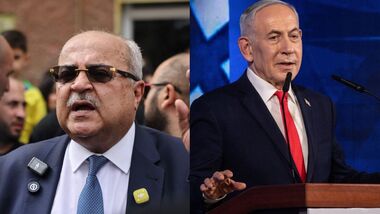
Days after Israeli Prime Minister and his right-wing bloc failed to secure a majority in the Knesset, the Joint List, an alliance of predominantly Arab political parties in Israel, said it was willing to help opposition parties form the next government.
According to The Times of Israel, senior Arab Member of the Knesset (MK) Ahmad Tibi said on Saturday (local time) that his party was ready to support the anti-Netanyahu Zionist parties in replacing Netanyahu and his coalition, but added that he did not want to be part of the government.
Tibi called on leading opposition candidate and Netanyahu rival to “be like [the late prime minister Yitzhak] Rabin,” citing Rabin’s reliance on Arab lawmakers’ votes to secure parliamentary approval for the Oslo Accords with the PLO.
Tibi, whose Joint List, an alliance of three Arab factions, won 11 seats on Tuesday, said, “We want to help anyone who wants to bring down this awful government… and switch it for a different government. We want to be part of the correction, part of the hope.”
He further said, “We won’t be part of the government. I don’t want a ministerial post. I don’t want to be in the cabinet,” adding, “But without the Arab parties there won’t be change.”
He suggested that the Joint List would ask President to task a candidate from the anti-Netanyahu Zionist parties, likely Eisenkot, with forming a government.
The party would also support removing Likud’s Amir Ohana as Knesset speaker and establishing a state commission of inquiry into the Hamas-led attack on 7 October 2023, he indicated. The anti-Netanyahu bloc plans to prioritise both measures after the new Knesset takes office on 10 November.
In another interview, party chairman Yousef Jabareen said talks had begun with most opposition bloc leaders. He declined to describe Hamas as a terrorist organisation, a condition Eisenkot has set for prospective coalition partners, and rejected claims that Qatar had interfered in the election to increase Arab turnout.
The Jewish-led opposition parties and Arab-led factions together won 67 seats, enough for a majority in the 120-member Knesset. However, that numerical advantage depends on their willingness to cooperate.
Tuesday’s elections recorded the highest voter turnout in decades, with 77.9% of eligible voters casting a total of 5,716,665 ballots. The full official results are scheduled to be presented to Herzog on 4 November, after the Central Elections Committee (CEC) concludes any final inquiries into errors or complaints. Following this, Herzog will meet with each party leader as they recommend the person they believe should form the next government.
Likud, led by , secured 27 seats in the final count, followed by Yashar with 21, B’Yachad with 12 and the Joint List with 11. The Democrats and Ra’am each won eight seats, while Yisrael Beytenu, United Torah Judaism and Otzma Yehudit took seven apiece. Shas and Religious Zionism each secured six seats.
The new Knesset will be sworn in on 10 November, even if negotiations over the next government remain unresolved. Talks are expected to be difficult and could last more than two months, as neither main bloc is close to securing the 61 seats needed for a majority.
On Wednesday, Herzog called on party leaders to work towards preventing another election. “We must do everything we can, certainly after yesterday, to avoid another round of elections. So I expect everyone who comes here to come with an open mind,” he said.