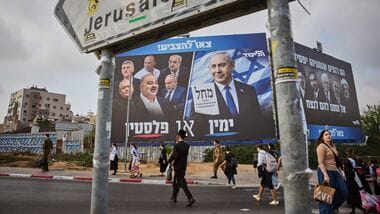
Israel heads to a crucial general election on October 27, with Prime Minister Benjamin Netanyahu facing a formidable challenge from an opposition led by former military chief Gadi Eisenkot.
While Netanyahu’s political future hangs in the balance, the election may not be decided by the popular vote alone.
Israel’s coalition-based parliamentary system means even a party that finishes behind its rivals could remain in a position to form the government.
The outcome could shape Israel’s approach to the war in and wider regional conflicts, its relations with the United States and Europe, and the country’s domestic political trajectory.
For India, the stakes extend to defence cooperation, trade, energy security and New Delhi’s broader diplomatic interests in West Asia.
As Israelis voted on Tuesday, Netanyahu’s party is locked in a close contest with Eisenkot’s opposition alliance.
This is Israel’s first nationwide election since the Hamas-led attacks of October 7, 2023, which killed 1,195 people and saw 251 others taken hostage in .
The assault triggered a prolonged military campaign and years of conflict across multiple fronts.
The attacks exposed major intelligence and security failures, prompting widespread criticism of Netanyahu and his government’s preparedness.
Many of his opponents accuse him of repeatedly evading responsibility for the failures that preceded the assault and the security establishment’s response.
The events of and their aftermath have left deep grief, insecurity and political divisions across Israeli society.
Israel’s electoral system makes the final outcome more complicated than a straightforward contest between the two leading political camps. Voters elect parties to the 120-member , or parliament, through proportional representation. No single party has traditionally secured enough seats to govern alone, making coalition negotiations central to the formation of every government.
The key question is whether Netanyahu’s Likud party and its potential right-wing and religious allies can collectively command a majority of at least 61 seats. Even if Likud finishes behind its principal rival in terms of seats, could still have a path to power if his allies secure enough seats to form a governing coalition.
Conversely, an opposition party or alliance that wins the largest number of seats may still struggle to form a government if its partners cannot agree on a common programme or reach the required majority.
The fate of smaller parties could prove as consequential as the performance of the two main political camps. Under Israel’s electoral system, a party must secure at least 3.25% of the valid vote to enter the Knesset, a threshold that translates into roughly four seats.
Several smaller parties hovering near the cutoff could determine which bloc emerges with the stronger parliamentary position.
Analysts expect the outcome to depend not only on voters switching sides but also on which parties manage to enter parliament and how many seats they win.
Netanyahu, widely known as Bibi, has dominated Israeli politics for decades, serving as prime minister for nearly 19 years across different periods in office.
Security has long been central to his political appeal, and he has repeatedly survived electoral setbacks and political crises.
But the fallout from October 7 has presented one of the most serious challenges of his career.
Critics argue that his leadership has become inseparable from the failures preceding the attacks and the prolonged conflict that followed.
His supporters continue to view him as an experienced leader capable of navigating Israel through a volatile regional environment.
If the opposition wins more seats but cannot unite around a viable coalition, Netanyahu could yet retain power.
If his traditional allies lose ground or fail to secure enough seats collectively, even his long experience in Israeli politics may not be enough to save his government.
For Israel, the election could determine the country’s direction after October 7. For , it could decide whether he remains at the centre of national politics or finally loses his grip on power.