



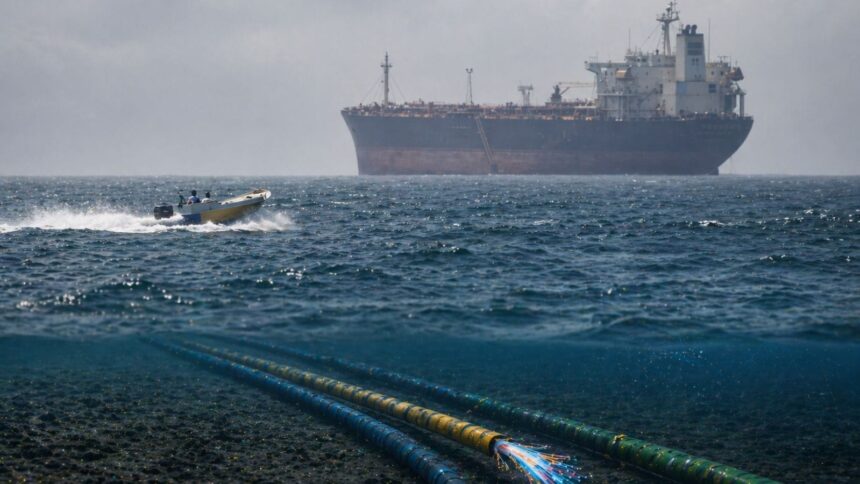
The Iran versus US and Israel war has drawn fresh attention to the Strait of Hormuz, not just as a vital oil artery, but as a potential “digital chokepoint” that could disrupt global internet infrastructure. Iran last week warned that submarine cables running through the strait remain exposed, raising concerns about risks to critical digital systems linking Asia, the Gulf and Europe, news agency Reuters reported.
Subsea fibre-optic cables carry roughly 99 per cent of global internet traffic, according to the International Telecommunication Union (ITU), making them essential for telecommunications, cloud services and financial systems.
“Damaged cables mean the internet slowing down or outages, e-commerce disruptions, delayed financial transactions … and economic fallout from all of these disruptions,” geopolitical analyst Masha Kotkin was quoted as saying.
Several major cable systems pass through the Strait of Hormuz, including:
The FALCON network, in particular, directly connects India (via ) to Gulf countries, acting as a major route for enterprise data, telecom traffic and business connectivity with West Asia. Any disruption could slow connectivity, hit financial systems and impact India’s IT-driven economy.
These cables underpin data flows for countries investing heavily in AI and digital infrastructure, particularly the UAE and Saudi Arabia.
🚨🇮🇷🇺🇸 As the war drags into week three, Iran’s choke point isn’t just oil, it’s the internet running under it.
The Strait of Hormuz and Red Sea carry cables powering banking, AI, and basically your entire online life… and they’re now sitting in a live fire zone.
Why this…
— Mario Nawfal (@MarioNawfal)
While submarine cables have not yet been directly hit, experts told Reuters that the risks are rising as the conflict nears two months.
Most cable faults, around 70–80 per cent, are caused by accidental human activity such as fishing or ship anchors. However, military operations increase the chances of accidental damage, especially from drifting vessels.
A similar incident occurred in 2024, when a vessel attacked by Iran-aligned Houthis .
“In a situation of active military operations, the risk of unintentional damage increases,” Kotkin said.
Even if cables are damaged, fixing them in a conflict zone is far from straightforward, according to the report.
Repair operations may be delayed due to:
“Often one of the biggest problems… is getting permits into the waters where the damage is,” telecom analyst Alan Mauldin told Reuters.
Post-conflict, companies may also need to resurvey seabeds to avoid hazards from sunken vessels or debris.
According to experts, there is no scalable replacement for subsea cables. Satellite networks, including low-Earth orbit systems like Starlink, cannot handle comparable data volumes and are significantly more expensive.
“It’s not as though you could just switch to satellite. That’s not an alternative,” Mauldin said.
The West Asia conflict is also disrupting global trade flows, . India produces nearly half of its 4.2 million metric tonnes of aluminium via recycled scrap, much of it imported from the EU, the US and the Middle East, which accounts for about 30 per cent of supplies.
Supply disruptions have led to:
“There is a hand-to-mouth situation in scrap plants because of shortages and price increase,” said Sandeep Jain of Sunalco Alloys.
The supply crunch is expected to ripple which consumes about 60 per cent of secondary aluminium.
Major automakers such as Suzuki, , Mahindra & Mahindra and Hyundai Motor India may face rising input costs, Reuters reported.
“Prices have been impacted, which will eventually be passed on to carmakers and ultimately, the buyers,” said Dhawal Shah of Metco Ventures.

