



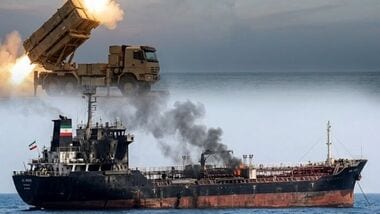
Iranian media on Tuesday (September 8) reported that a US missile struck a small Iranian tanker near Kharg Island, with no casualties reported, as tensions between Tehran and Washington continued to escalate. The reports came alongside an Iranian claim that its Revolutionary Guards had intercepted and destroyed an advanced MQ-1 drone over the Strait of Hormuz.
Iran’s Tasnim news agency reported that a small Iranian tanker was targeted by a US missile about four miles from Kharg Island, a major hub for the country’s oil exports.
Tasnim said the vessel was hit by a projectile fired by US forces operating near the Kharg Island anchorage. No casualties were reported.
The claim has not been independently verified.
The reported tanker strike came shortly after Iranian local media reported hearing several explosions on Kharg Island.
The island is strategically important to Iran’s energy sector, as a large share of the country’s crude oil exports is shipped through its facilities.
Iranian media also reported two explosions in the southern port of Jask, adding to concerns over attacks on Iranian energy and maritime infrastructure.
In a separate statement carried by Iranian state television, the Islamic Revolutionary Guard Corps said it had thwarted a drone attack over the Strait of Hormuz.
The Guards claimed an advanced MQ-1 drone was intercepted and destroyed by what it described as a new advanced Iranian defence system operating under the country’s integrated air defence network.
The IRGC did not identify the operator of the drone. The MQ-1 model is used by only a small number of countries, including the United States.
Iranian Armed Forces chief of staff Ali Abdollahi warned that Tehran would target US bases across the region if Iranian oil tankers were attacked.
According to state television, Abdollahi said the US military had issued evacuation warnings to Iranian oil tankers before possible strikes.
He warned that any attack on Iranian oil tankers would trigger attacks on US bases in the region by Iranian armed forces.
US Secretary of State Marco Rubio meanwhile accused Iran of being behind attacks carried out by Yemen’s Houthi rebels against Saudi Arabia.
Rubio said the Houthis were in many ways agents and proxies of Iran and that the “Iranian hand” was clearly behind some of the attacks.
The comments came as the Houthis launched a new offensive to seize territory near the Bab al-Mandab Strait, a key maritime chokepoint connecting the Red Sea with the Gulf of Aden.
Washington also expanded its economic pressure on Tehran by imposing sanctions on what it described as all remaining Iranian airlines that had not previously been penalised.
The US Treasury Department said the latest measures target 36 entities and individuals supporting Iran’s aviation sector, which Washington alleges is used to transport weapons, personnel and illicit cargo.
Despite the escalating military tensions, Iran said diplomatic efforts with Oman over the administration of the Strait of Hormuz were making progress.
Foreign Minister Abbas Araghchi said there had been “significant progress” in the talks, which the two countries have been holding for weeks.
Iran’s Foreign Ministry said Araghchi discussed the latest status of the negotiations with his Japanese counterpart and reported significant progress in the Iran-Oman discussions.
Separately, Israel conducted a wave of airstrikes in south Lebanon on Monday, killing 13 people, including women and children, according to Lebanon’s Health Ministry.
The strikes marked an intensification of violence following a weeks-long lull in fighting. No new Israeli strikes were reported in the region as of early Tuesday evening.