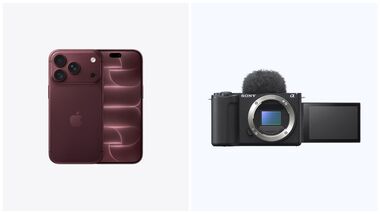
Looking for a camera and confused whether you should go for the best smartphone camera or just a camera with all the features a professional needs? We’ve got you covered as we bring to you a comparison between the Apple and Sony’s ZV-E10 Mark II.
Sensor: iPhone 18 Pro comes with multiple camera sensors and does computational image processing.
The Sony ZV-E10 II has an approximately 26MP APS-C sensor.
Camera system: The iPhone has three rear cameras while the Sony ZV-E10 II has one camera body with interchangeable E-mount lenses.
Focal lengths: The iPhone comes with a 13mm ultra-wide, a 24mm main, and a 100mm telephoto focal length. On the other hand the focal length of the Sony ZV-E10 II depends on the lens you attach.
Image quality: The iPhone provides computational processing that produces polished, ready-to-share images. The Sony has a large sensor that offers greater potential for detail and tonal control.
Dynamic range: Apple Log 2 supports greater flexibility in video grading while Sony’s larger sensor offers strong dynamic-range potential.
Low-light performance: The iPhone’s processing power can brighten scenes and produce attractive results. However, Sony’s larger sensor can capture more light if paired with a suitable lens and settings.
Video stabilisation: The iPhone is the best for video stabilisation, which is one of its major strengths. The Sony camera’s active stabilisation is not as effective in certain situations.
Ease of use: The iPhone is much easier to use when compared with the Sony ZV-E10 II. The iPhone can quickly capture and process the image, making it ready for sharing. However, the Sony camera has more settings and equipment choices that hve to be managed.
Everyday photography: The iPhone is convenient for every photographs like street photography, travel, family events, and social media. It beats the Sony ZV-E10 II in this regard.
Professional work: The APS-C sensor and interchangeable lenses of the Sony ZV-E10 II give greater control over depth of field, lens character, exposure, and framing, thus making it the device to use when it comes to professional photographers.
Vlogging and handheld video: The iPhone, with its impressive image stabilisation and ease of carrying around wins this round. The Sony can need a gimbal or other forms of stabilisation support for vlogging.
The device you end up buying depends on your requirements. If you need one easy-to-carry device that will constantly give you good quality images and also help in quick video recording without much hassle, opt for the iPhone 18 Pro.
However, if you need a more dedicated camera for content creation, or are a professional photographer who needs more control over lenses, depth of field, and image character, the Sony ZV-E10 should be your device of choice.