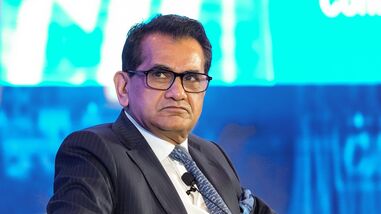
India is strengthening its position in the global clean energy market, with 14 binding green supply deals signed in the first four months of 2026 covering 311,520 metric tonnes of annual supply, former NITI Aayog CEO and G20 Sherpa said in a post on social media platform X.
Of the contracted volumes, 62% are destined for export markets, highlighting the country’s ambitions to become a supplier of low-carbon fuels to international buyers.
“India’s green hydrogen ambition is going global. 14 deals in just the first four months of 2026, 311,520 tonnes of annual supply, with 62% destined for export markets. India is emerging as a key player in the global clean energy trade,” Kant wrote.
India’s progress in green hydrogen is part of a broader shift in its energy transition strategy, which combines domestic decarbonisation with opportunities to supply clean fuels to international markets.
According to BloombergNEF‘s India Transition Factbook 2026, published on 13 October, Indian companies signed binding contracts in the first four months of 2026 to supply about 0.3 million metric tonnes of clean hydrogen annually, including volumes exported as green ammonia. This made India the country with the highest contracted volumes signed during that period and lifted it to third place globally in cumulative contracted volumes.
The report said India’s ability to produce green ammonia at competitive prices, supported by relatively low-cost clean power, subsidies and competitive auctions, has helped attract overseas buyers. Indian companies have also signed three major binding offtake agreements covering exports of more than 1 million metric tonnes annually.
Green ammonia is produced using hydrogen made through renewable-powered electrolysis and nitrogen. It can be used as a fertiliser feedstock and as a carrier for transporting hydrogen-based energy, making it an important part of the emerging international clean fuel trade.
The government’s is central to India’s ambitions in the sector. Approved in January 2023 with an outlay of ₹19,744 crore, the mission aims to establish India as a global hub for green hydrogen production, use and exports.
The programme includes financial incentives for electrolyser manufacturing and green hydrogen production, alongside measures to create demand in industries such as fertilisers and refineries.
In March 2026, the Ministry of New and Renewable Energy said 3,000 MW per annum of electrolyser manufacturing capacity had been awarded to 15 companies. Separately, 18 companies had been awarded green hydrogen production capacity of 862,000 metric tonnes per annum under the mission’s incentive schemes.
The government has also pursued demand aggregation for green ammonia, a hydrogen derivative that can help create a domestic market while supporting the development of production and supply infrastructure.
These initiatives are intended to build an ecosystem spanning renewable electricity, electrolysers, hydrogen production, industrial consumption and exports.