




While the Indian government has spent the past several years looking to rein in dark patterns across online platforms, the financial toll exacted on consumers who fall for such deceptive design practices has remained largely hidden.
Now, a new study estimates that dark patterns incur an aggregate loss of Rs 25,000 to Rs 28,000 crore a year to Indian consumers through hidden fees, auto-subscriptions, and pre-selected add-ons already deducted from wallets. The 88-page report titled ‘Dark Patterns in India’s Online Marketplaces’ was published by Gurugram-based consumer insights firm Datum Intelligence on Tuesday, June 9.
Over 88 per cent of 304 million Indian online buyers are affected, with each of them losing an estimated Rs 78-87 every month to various types of dark patterns, including hidden fees, basket sneaking, drip pricing, and false urgency, according to the report.
Dark patterns could also potentially undermine the very platforms that deploy them, with frustrated consumers spending less, ordering less frequently, or abandoning services altogether. The report estimates that (Gross Merchandise Value) is at risk as users reduce spending or switch platforms. “This is revenue that platforms have not yet lost, but will,” the report read.
Despite these negative effects, 73 per cent of platforms analysed by Datum researchers continue deploying forced action designs that push users into unintended actions or purchases, with Indian players such as Nykaa, BigBasket, and ClearTrip emerging as the worst-performing platforms in their respective sectors on Datum’s dark pattern index.
The findings of the study come days after the Central Consumer Protection Authority (CCPA) penalised edtech firm PhysicsWallah and cybersecurity company McAfee Software India for deploying dark patterns in violation of the Guidelines for the Prevention and Regulation of Dark Patterns, which was notified by the regulator in 2023 and identified 13 such practices as unfair trade practices.
Since then, a handful of platforms including Rapido, Zepto, and FirstCry have faced fines for not adhering to the guidelines. However, the lack of regulatory clarity and enforcement gaps have hampered progress. Quick commerce app Zepto, for instance, was fined Rs 7 lakh by the CCPA just six weeks after submitting a self-declaration of compliance, this highlighting the limits of the current self-audit framework and the need for stronger verification mechanisms, as per the report.
“Dark patterns are not glitches. They are deliberate, engineered design choices that exploit consumer psychology […] The combined impact of direct financial loss and changing consumer behaviour shows that dark patterns are no longer just a consumer-protection concern. They are a broader macroeconomic challenge for the long-term sustainability of India’s digital commerce ecosystem,” Datum Intelligence founder Satish Meena said in a virtual media briefing.
The report was conducted in Q1 2026. Researchers surveyed over 2,590 consumers across 50 cities and assessed 12 leading platforms across quick commerce, e-commerce, and online travel booking.
The study examined a dozen platforms, namely: BigBasket, Zepto, Instamart, Blinkit, Amazon, Flipkart, Myntra, Nykaa, MakeMyTrip, EaseMyTrip, ixigo, and Cleartrip. It scored each of these platforms from 0 to 100 as part of its Benchmarking Index, where a lower score indicates fewer and less harmful dark patterns.
It also measured consumer harm posed by a platform based on estimated financial impact and erosion of trust by consumers.
– Varying consumer harm:While all 12 platforms deployed dark patterns at similar frequency, Datum’s B-Index revealed a 92-point gap between the best and worst performing platforms. In addition, consumer harm varied 15 times across the cohort with Amazon topping the index at 6.7 points and Nykaa ranked as the worst-performing platform across sectors with a B-Index score of 99 points (leading in all 11 dark pattern types and having the highest financial extraction figure per encounter).
-False urgency in quick commerce: Notably, the most common dark pattern deployed across all four quick commerce platforms is false urgency, where users are shown fake countdown times to create panic buying. False urgency scored the highest single-pattern score (3.02) measured by Datum. Additionally, Big Basket recorded the highest B-Index score (98.5) in the quick commerce category, which is behind 26-72 per cent hidden charges and 90 per cent users reporting forced cancellations.
-Drip pricing in online travel: A majority of online travel booking apps rely on drip pricing,where hidden charges are revealed only at the final checkout stage, with Flipkart-owned ClearTrip ranking among the most harmful platforms (85.2 B-Index score). In contrast, MakeMyTrip was found to be the safest online travel app with a 9.4 B-Index score and consumer trust scores exceeding distrust.
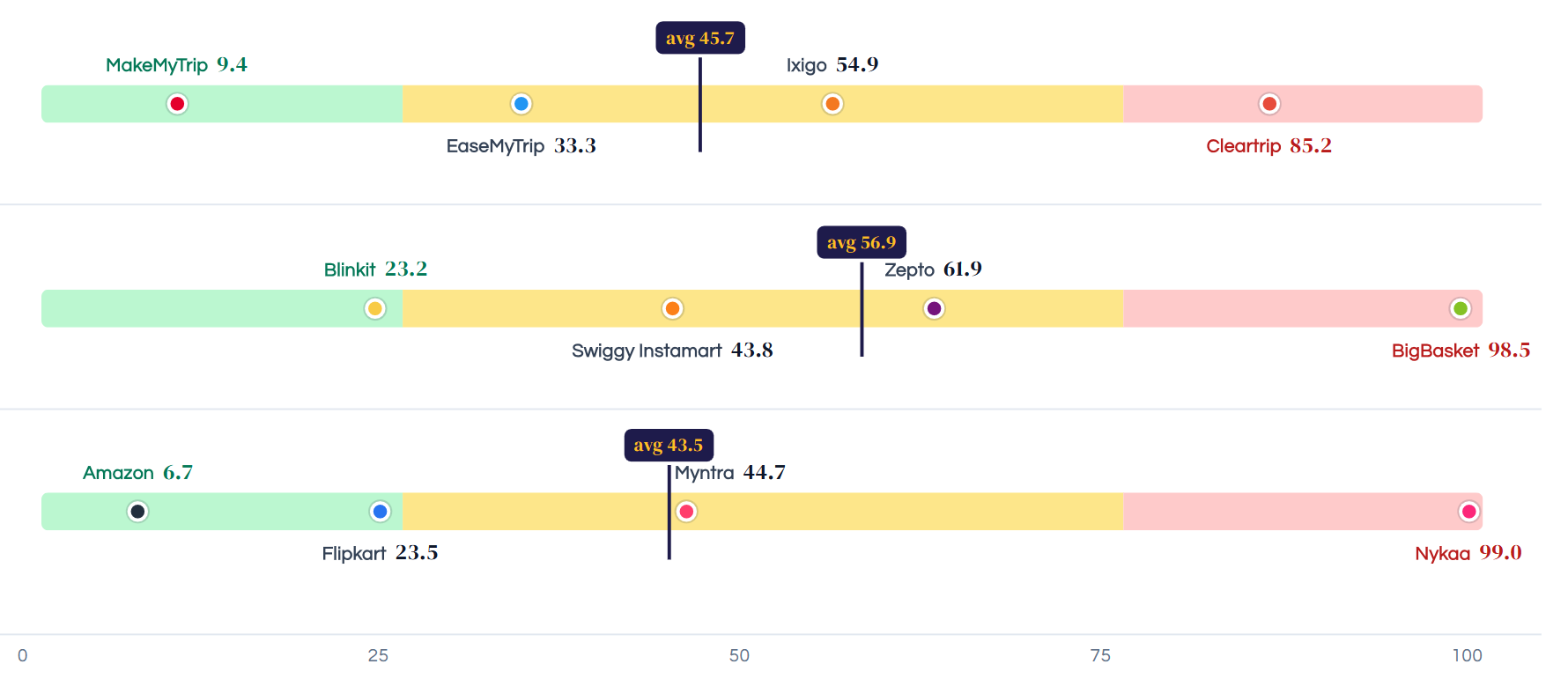 Sector Severity Distribution (Benchmarking Index [B Index], 0-100). (Image: Datum Intelligence report)-Shift in consumer behaviour: Deploying dark patterns could push users away, with 36 to 45 per cent of respondents stating that they use a platform less, spend less on it, or stop using it altogether after encountering dark patterns. The online travel category saw the highest exit signals with 15 per cent of respondents planning to cut use while 41 per cent switching to direct bookings on airline and hotel sites.
-Dark pattern awareness paradox: Over 81 per cent of consumers can identify a dark pattern when shown one, and 69 per cent want stricter regulation against dark patterns. However, the study found that 85 per cent of respondents still fall for dark patterns.
-Poor complaint resolution: Of consumers affected by a dark pattern, 53 per cent raise a complaint with the platform, and only 23 per cent receive a resolution they consider satisfactory at that same platform stage.
-Emerging trust economy: Over 74 per cent of consumers said that they are willing to pay more for platforms that commit to fair, transparent design – with only 10 per cent of respondents rejecting the proposal outright. This suggests that platforms rebuild trust, user spending will also recover, as per the report.
In its report, Datum highlights the lack of clarity in definitions laid down by the CCPA’s guidelines. For instance, when a flash sale genuinely has limited stock, there is no clarity on whether the countdown times is considered a dark pattern or factual disclosure. In other words, the CCPA’s guidelines do not distinguish between manufactured urgency and real supply constraints.
The report also pointed out that 26 platforms which had submitted self-declarations of compliance, were subsequently found ‘non-compliant’ in surveys. This suggests that “platforms and regulators are reading the same guidelines differently because the guidelines allow for multiple readings,” it read.
Datum further proposed the following three-stage implementation roadmap:
-Stage 1: Reduce the top three dark patterns by banning pre-selected insurance and add-ons across online travel, e-commerce, and quick commerce checkout flows, mandate all-inclusive pricing in search results rather than at checkout, and establish a fast-track complaint portal with 30-day resolution mandates.
-Stage 2: Make audit infrastructure operational by developing sector-specific dark-pattern audit standards for dark patterns, introducing mandatory quarterly UX transparency reports for platforms above Rs 500 crore GMV, and training consumer-court judges and CCPA investigators on UX testing.
-Stage 3: Establish an industry dark-pattern benchmarking index with quarterly scoring across all platforms, require annual third-party UX audits for all platforms above Rs 500 Cr GMV with results publicly available, and releasing an annual state-of-dark-patterns report with enforcement outcomes and platform compliance scores.

