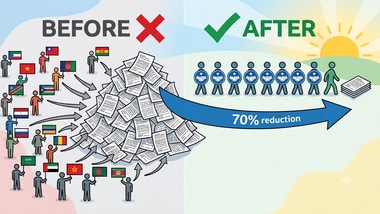
India has simplified its visa regime by reducing the number of main visa categories from 13 to nine and sub-categories from 49 to 23. The (MHA) has also rationalised visa application forms, reported ANI. According to the news agency, 23 categories and sub-categories have been revised, reducing the number of required columns or fields by 65% to 70%.
As per MHA, the move is aimed at reducing the time and effort required by foreign nationals to complete applications. It is also expected to improve the administrative efficiency through more focused scrutiny and processing.
“The Government of India has simplified its visa regime by reducing the number of main visa categories from 13 to 9 and the number of sub-categories from 49 to 23. The move aimed at making it more compact, coherent and responsive to the requirements of foreign nationals visiting India. To implement all changes made in the Indian Visa regime, the MHA is updating the IT systems, and by year-end, visas will be granted as per the new rationalisation,” said the MHA, as quoted by the news agency.
sa
The nine revised categories will include Business, Diplomatic, Work, Journalist, Medical, Official, Student, Visitor and Miscellaneous visas.
The ministry announced the latest changes on August 27, following an earlier rationalisation in October 2025, when categories were brought down from 22 to 13 and sub-categories from 63 to 49.
The MHA said the government studied visa systems in developed countries and global standards before undertaking the changes. Officials said implementing similar travel purposes is likely to make it easier for applicants to identify the an appropriate category.
Currently, India offers e-visas to nationals of 172 countries across 13 sub-categories.
The current has been renamed Visitor Visa and divided into two categories– V-1 and V-2. V-1 covers short visits for tourism, business meetings, medical, wellness and short-term cultural or language courses-related purposes with a validity of 30 days with multiple entries. V-2 covers longer visits, with validity of one, five or 10 years, and also includes mountaineering.
The involves conventional treatment under M-1 and AYUSH treatment under M-3. In both cases, entry is granted for one year with multiple entries. M-2 and M-4 visas are available to those accompanying a patient.
Meanwhile, student visas have been consolidated into two categories. While S-1 covers school and higher education, S-2 is for research scholars, visiting faculty, internships and exchange students. Eligible students can enrolled through the Study in India portal to receive their e-S1 visas for up to five years or the duration of their course, whichever is less.
Similarly, business visas have been divided into two categories. B-1 is for long-term, licence-based activities and B-2 is for short-term, contract-based business engagements. Production Investment Business visas which was earlier issued under the e-B4 nomenclature, will be available under B-2 going forward.
The ministry is currently updating its systems to implement the changes.
The revised framework is expected to come into effect by the end of this year, as per the MHA.