




What worsens this dependence is not merely the volume of imports, but the inefficiency with which India utilises them.
The core issue of India’s fertiliser challenge lies in the imbalance of nutrient application. An optimal fertiliser ratio of nitrogen, phosphorus, and potassium is crucial for achieving maximum agricultural yields. However, in practice, India’s fertiliser usage has significantly deviated from this balance, exhibiting a persistent preference for nitrogen. This inclination is primarily influenced by subsidy policies that make urea disproportionately cheap.
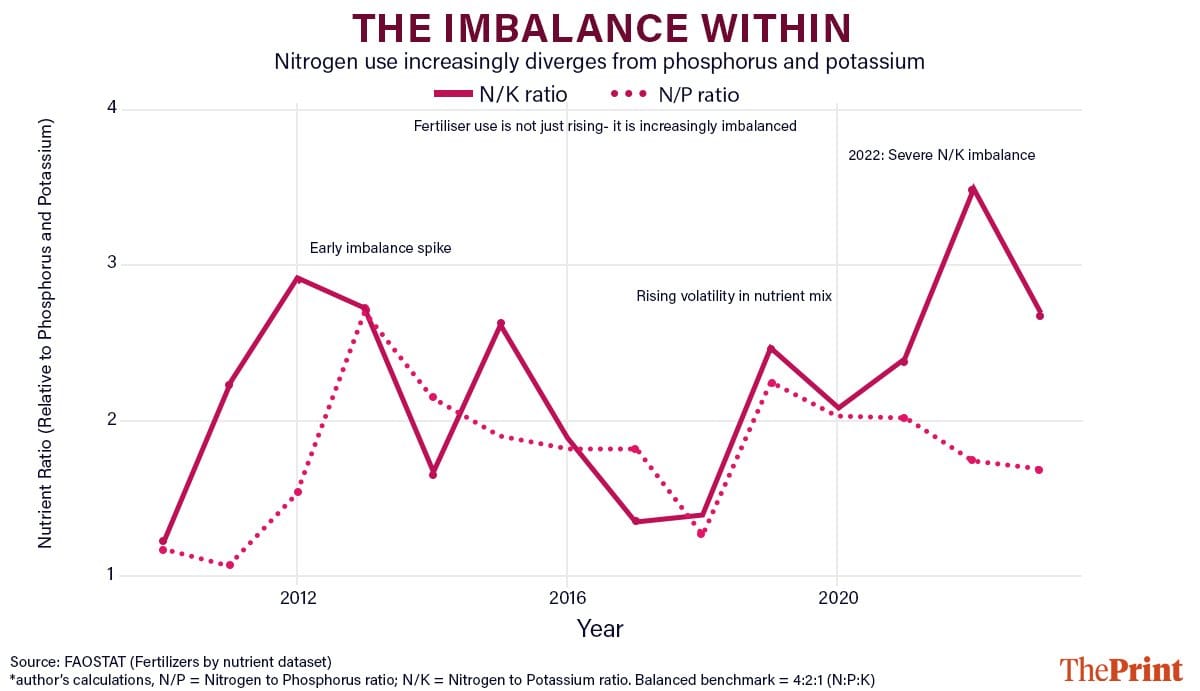
The data indicates volatility rather than convergence. In years where productivity declines, nitrogen ratios exhibit significant increases, reflecting distorted incentives.
For several decades, subsidies have rendered urea disproportionately cheap compared to phosphatic and potassic fertilisers. Consequently, farmers acting rationally, tend to overuse nitrogen, resulting in nutrient imbalances, reduced efficiency, and a cycle of increasing dependency.
This is where the fundamental principle of agricultural economics, known as Liebig’s Law of the Minimum, holds that agricultural output is constrained not by the total availability of inputs, but by the most limited one. In the context of Indian agriculture, this limiting factor is rarely fertiliser alone. Instead, it fluctuates among water scarcity, soil degradation, and nutrient imbalance. When these constraints become binding, the addition of more fertiliser does not enhance output; rather, it merely increases inefficiency.
The consequences are already evident. Levels of soil organic carbon are diminishing, thereby reducing the soil’s capacity to retain nutrients and moisture. Micronutrient deficiencies, particularly zinc and iron, are widespread. In regions with high-input usage, soils are experiencing chemical stress, including acidification and salinity. The fertiliser response ratio, defined as the output per unit of fertiliser, has significantly decreased, with each additional unit now yielding less output than previously. What may appear as increased input usage is, in fact, a decline in effectiveness.
Policy has acknowledged this issue, albeit inconsistently. The , initiated in 2015, was intended to provide farmers with guidance on nutrient application based on soil analysis. However, its execution has been inconsistent, and its adoption remains limited.
In a stable global environment, inefficiency incurs costs but remains manageable. However, in a context characterised by disruption, inefficiency becomes dangerous. The production of fertilisers is intrinsically linked to natural gas, which is predominantly located in geopolitically sensitive regions. Similarly, the supply chains for phosphates and potash are highly concentrated, with nations such as China exerting significant influence through their export policies. When these supplies are disrupted, India faces limited flexibility, as it cannot readily substitute inputs or rapidly scale domestic production. Due to its inefficient usage, India necessitates greater imports than a balanced system would require.
Consequently, India’s inefficiency in fertiliser usage worsens its dependence on imports precisely when the reliability of these imports is diminishing. The PM-PRANAM (Promotion of Alternate Nutrients for Agriculture Management) Scheme aims to incentivise states to by sharing the savings from subsidies. However, without addressing the underlying price distortions, its impact is likely to remain limited.
Several countries facing similar constraints have opted to redesign their systems, not by diminishing agricultural ambitions, but by enhancing efficiency and managing dependency.
In China, the fertiliser strategy is integrated with energy and industrial policy. The use of mitigates reliance on imported gas, albeit with environmental repercussions, while export controls ensure domestic availability. Importantly, nationwide soil testing programmes guide fertiliser application, aligning usage with actual soil requirements and preventing excessive demand.
Indonesia has concentrated on upstream control. By production and establishing a coordinated, state-backed supply chain, it has reduced, though not entirely eliminated, exposure to global price volatility. The lesson here is evident: fertiliser policy cannot be dissociated from energy policy.
In Israel, scarcity has driven innovation. deliver nutrients directly to plant roots, dramatically enhancing absorption efficiency. The outcome is increased productivity with reduced fertiliser intensity, thereby decreasing the need for imports per unit of output.
Brazil has adopted a soil-first approach. Through , it has improved fertiliser efficiency while remaining import-dependent. The focus has been on maximising the productivity of each unit of fertiliser.
The consistent lesson across these cases is that countries do not eliminate dependence; rather, they reduce import intensity by optimising input utilisation.
India’s challenge with fertilisers extends beyond mere supply issues; it encompasses structural concerns. Firstly, reforming subsidies is crucial. As long as nitrogen remains artificially inexpensive, imbalances and excessive demand will continue. Secondly, enhancing efficiency is the fastest method to reduce reliance on imports. Every unit conserved through improved targeting equates to a unit not imported.
Thirdly, upstream security must be strengthened through diversified sourcing, long-term agreements, and the acquisition of overseas assets. Fourthly, precision agriculture, focusing on soil testing, micro-irrigation, and data-driven applications must be expanded beyond pilot programmes. Finally, fertiliser policy must be integrated with broader agricultural constraints, including water management, soil health, and climate variability.
India’s challenge with fertilisers lies not in scarcity, but in structural inefficiencies. The nation does not face a shortage of inputs; rather, it utilises them inefficiently, imports them excessively, and subsidises them disproportionately. In an era characterised by increasing uncertainty in global supply chains, such inefficiency is not only imprudent but also risky.
Reducing dependence on fertiliser imports does not necessitate the complete elimination of imports; instead, it requires minimising the volume of imports necessary to achieve the same level of output. This transition from dependence to efficiency is imperative for India. The underlying issue is already visible. The critical policy question is whether India will proactively reduce its dependence before an external shock compels it to do so.
Bidisha Bhattacharya is Consulting Editor (Economy) at ThePrint. She tweets @Bidishabh. Views are personal.
(Edited by Aamaan Alam Khan)

