



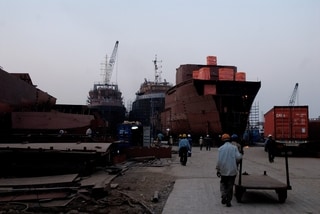
India aims to handle its entire export-import trade using Indian-flagged and domestically built ships by 2047 as part of plans to cut reliance on foreign shipping and become a major global maritime power, Union minister for ports, shipping and waterways Sarbananda Sonowal said on Wednesday.
Speaking at the third edition of Sagarmanthan: The Great Oceans Dialogue in New Delhi, Sonowal said the government’s Maritime Amrit Kaal Vision 2047 outlines a self-reliant maritime ecosystem across ports, shipping, shipbuilding, ship repair, maritime education, and skills.
“India wants to become self-reliant for shipbuilding,” Sonowal said, adding that the long-term objective is to build sufficient domestic capacity to meet the country’s shipping requirements and reduce dependence on foreign-flagged vessels. India is targeting a port cargo-handling capacity of 10,000 million tonnes by 2047, a substantial expansion from current levels, as it seeks to position itself as a global maritime hub.
The minister said the government was developing an ecosystem that would enable Indian shipyards to compete for international orders. Cochin Shipyard, for instance, has received shipbuilding orders from countries including Germany, the US and Norway, he said.
Sonowal said India also wants to become one of the world’s top five shipbuilding nations. The government is expanding shipbuilding and repair infrastructure and strengthening maritime education and training to create the skilled workforce required to support the industry.
India is already the world’s second-largest supplier of seafarers, with the number of Indian seafarers rising from around 170,000 to more than 323,000, Sonowal said. The country also accounts for more than 36% of global ship recycling, he added.
The minister said improvements in port infrastructure and cargo-handling systems had reduced container turnaround time from more than 35 hours earlier to about 23 hours. About 95% of India’s trade by volume is transported by sea, making maritime infrastructure critical to the country’s external trade.
The minister also disclosed the extent of the human cost of the ongoing maritime security crisis around the Strait of Hormuz, suggesting that 11 Indian seafarers have so far lost their lives amid attacks and incidents involving commercial vessels.
Sonowal said there had been four incidents involving Indian-flagged ships, while 74 incidents involved foreign-flagged vessels bound for India and carrying Indian seafarers.
The government has evacuated more than 4,000 Indian seafarers from the affected region, he said. It is also maintaining vessel-level monitoring and staying in contact with seafarers and their families through its maritime security and coordination mechanisms. The government had previously said it was tracking Indian seafarers irrespective of their vessel’s flag.
The latest figures cited by Sonowal indicate that the security challenge extends well beyond Indian-flagged vessels, given the large number of Indian seafarers employed on foreign-flagged ships. India has the world’s second-largest maritime workforce, making the safety of its seafarers an important component of the country’s maritime policy.
Sonowal said India was also using Sagarmanthan to deepen bilateral maritime cooperation. Discussions were held with delegations from Belgium, Myanmar, Lithuania and Bhutan, among other countries.
Belgium has expressed interest in working with India on green shipping and related maritime initiatives, he said. Discussions with Saudi Arabia are also progressing towards institutional mechanisms for cooperation, including in the energy sector.
Bhutan, meanwhile, is interested in using India’s river ports and inland waterways to move its export cargo, Sonowal said. India is developing a network of river ports and inland-waterway infrastructure that could provide neighbouring landlocked countries with access to maritime trade routes.
The minister said India’s maritime infrastructure should not only serve domestic cargo but also provide neighbouring countries with efficient access to international markets.
The third edition of Sagarmanthan has attracted participation from more than 70 countries, including ministers, maritime industry representatives and international experts. Sonowal said the growing participation demonstrated the increasing importance of the dialogue as a platform for cooperation on shipping, shipbuilding, ports, maritime security and the wider ocean economy.
The government’s long-term maritime strategy, he said, is aimed at combining higher port capacity with domestic shipbuilding, a larger Indian-flagged fleet, skilled manpower and stronger regional connectivity to make India a self-reliant maritime economy by 2047.