



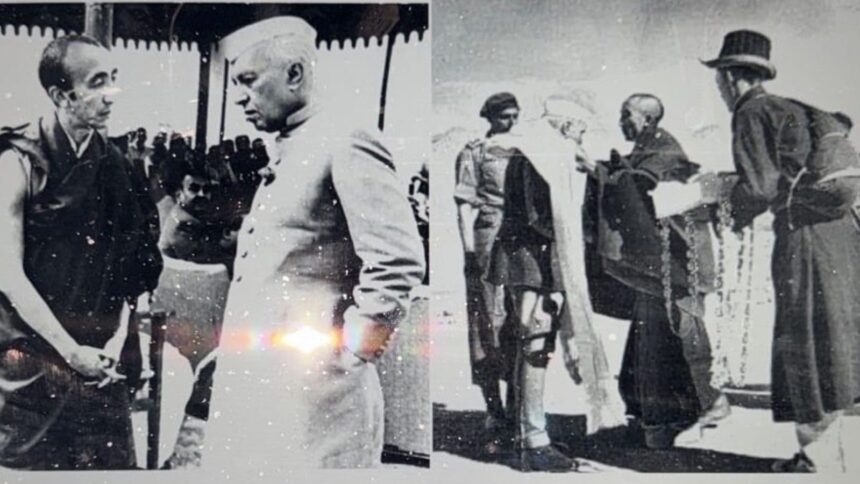
The day the Piprahwa relics landed on the small airstrip in Leh, hundreds of people gathered to catch a glimpse. Once the relics were on their way to Jivetsal, to be displayed for two weeks, Leh saw an unprecedented traffic jam that extended as far as the eye could see.
Tsering Dorjay Lakrook, the president of the Ladakh Buddhist Association, would later say that the arrival of the relics was marked by auspicious signs such as the clearing of clouds over the mountains and the appearance of a rainbow over Spituk Monastery.
This wasn’t the first time the Buddha’s relics had come to the valley, though – they had been brought to Leh for a public exhibition earlier in 1950.
“The war with Pakistan in 1947 had left the Ladakhi community shaken,” Ladakhi scholar and diplomat Sonam Wangchuk Shakspo said. “The Pakistanis had almost reached Taroo village, around 15-20 km from Leh,” he said.
As the Pakistani forces advanced through Nubra valley, the religious head of Ladakh, the 19th Kushok Bakula Rinpoche, gathered local forces to buttress the Indian Army’s efforts to secure the valley.
According to the Ministry of Defence’s biography of Colonel Chewang Rinchen — the 17-year-old boy who led the Nubra Guards to victory in the war — the local forces played a key role in India’s victory in the 1947-48 war.
According to Shakspo, the Kushok Bakula convinced Prime Minister Jawaharlal Nehru to send the relics to Ladakh to lift the “spiritual morale” of the local population. The relics were displayed to the public for 79 days in May 1950.
The exhibition is mentioned in Nawang Tsering Shakspo’s book, A Cultural History of Ladakh: “On May 26th, 1950 the relics of two of the main disciples of Lord Buddha were brought to Ladakh. On this occasion Yeshes-don-grup had to give a speech about the significance of the relics to the public. In honour of the celebration of Buddha’s birthday on the 15th of Vaishakhi month he composed poems related to the occasion.”
Scholars and diplomats today view the 1950 Leh exhibition as part of a broader effort by newly independent India to deploy Buddhist heritage as a form of cultural diplomacy, both in the frontier regions such as Ladakh, and among Buddhist-majority countries across Asia. Over the following decades, relic exhibitions and Buddhist conferences would become an important component of India’s soft power outreach.
According to the Piprahwa Project, the Buddha relics were first displayed in Sri Lanka in 1978. This was followed by exhibitions in Mongolia in 1993, Singapore in 1994, South Korea in 1995, and Thailand in 1996.
In 2012, at the request of the Sri Lankan President Mahinda Rajapaksa, the relics once again travelled from India to Sri Lanka to commemorate the 2600th anniversary of the Enlightenment of the Buddha. The relics were taken to Sri Lanka by a delegation led by then Minister of Culture Kumari Selja.
The 19th Kushok Bakula felt deeply for the Buddhist communities in Russia and Mongolia. He became the first Buddhist monk to visit these countries, where he advocated for peace and nuclear disarmament.
The Asian Buddhist Conference for Peace (ABCP) was co-established in 1969 by the Bakula Rinpoche along with S Gombojav, the abbot of Gandantegchinlen Monastery in Ulaanbaatar. The Kushok Bakula shaped the policies and programs of the ABCP as the vice president, and later president, of the organisation.
After the collapse of the Soviet Union, Rinpoche, who was then the Indian ambassador to Mongolia, worked to organise an exhibition of the Buddha’s relics in Ulaanbaatar.
“When the relics arrived in the Mongolian capital, they were treated like state guests,” Shakspo, who worked closely with the Rinpoche during his ambassadorship years in Mongolia, said.
“People lined up outside the exhibition hall from morning to evening. It was a massive success. Thereafter, all Buddhist countries began requesting similar exhibitions – Vietnam, Thailand, Bhutan, and Sri Lanka,” he said.
The author was in Leh during the public exposition of the Sacred Piprahwa Relics of Lord Buddha earlier this month at the invitation of the Ladakh L-G.

