



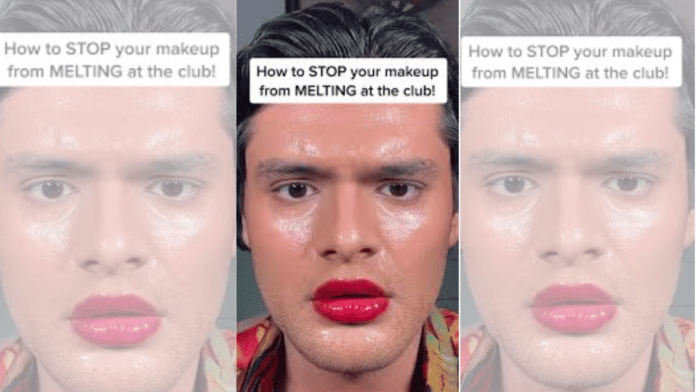
There is nothing wrong with your skin. There is something wrong with what you’ve been told to expect from it.
Let’s start with the uncomfortable truth: Skin is an organ, not a filter.
The beauty industry has quietly convinced an entire generation that shine is a sign of failure.
Thanks to social media and Photoshop, we expect skin to be flawless, poreless, dry-looking, or perpetually matte—untouched by sweat, oil, or reality. And if your face doesn’t behave that way, there must be a product to “fix” it.
Skin is not designed to stay matte.
Especially not in Indian weather. Especially not under stress. And certainly not under layers of makeup, lights, and expectations.
Sweating is not your flaw—it is your physiology.
Sweat is a fundamental biological function. It regulates temperature, responds to emotional cues, and keeps your body from overheating. The face, in particular, has a dense concentration of eccrine sweat glands—making it one of the first areas to show sweat.
So when your upper lip beads up before a presentation, or your forehead glistens in humidity, your body is not betraying you—it is doing its job.
Yet, every day patients sit across from me, apologising for it. That, to me, is the real problem. Why are we apologising over a biological reaction?
Let’s call this out clearly—because dermatologists rarely say it bluntly enough. Most “matte” products are solving the wrong problem.
They are designed to absorb oil. Not sweat.
Oil (sebum) and sweat are entirely different substances. One is lipid-based, the other water-based. You cannot “powder away” active sweating.
At best, these products will temporarily reduce surface shine, create a blurred, filtered appearance, or hold makeup in controlled conditions.
At worst, they will give false expectations, lead to product layering and pore congestion. And eventually leave users frustrated when biology breaks through in 20 minutes.
That is when the blame shifts back to your skin.
What concerns me as a dermatologist is not just the inefficacy—it is the psychology.
We are selling people the idea that every natural function must be controlled, minimised, or hidden.
Sweat becomes something to “fight.” Shine becomes something to “fix.” And normal physiology becomes a cosmetic failure.
This is not skincare. This is conditioning. But then, comes the question: When should you actually worry?
Let’s be medically responsible. Not all sweating should be dismissed.
If your facial sweating is occurring without triggers and interferes with daily life and is associated with symptoms like palpitations, weight loss, or night sweats, it may be a cause for concern. Such excessive and persistent facial sweating may point toward hyperhidrosis or an underlying systemic issue such as thyroid imbalance, metabolic disorders, or medication effects. That is when you should see a doctor—not a beauty counter.
Let’s separate reality from retail.
What helps:
* Blotting papers—simple, effective, underrated
* Lightweight, gel-based skincare
* Minimal layering, especially in humid weather
* Strategic use of powders (not overuse)
What helps medically (when needed):
* Clinical antiperspirants (used cautiously on the face)
* Prescription treatments
* Botulinum toxin (Botox) for severe cases
What does not help:
* Expecting a 12-hour matte finish in 40°C heat
* Layering multiple “oil-control” products, hoping to stop sweat
* Believing influencer claims without understanding skin physiology
Here’s what people don’t say out loud—but I hear every day in my clinic: “I avoid meetings because I sweat.” “I don’t wear makeup anymore—it just melts.” “I feel people are staring at my face.” These are not complaints, but the everyday realities many now face as a result of extreme social pressure for that “perfect” skin.
Facial sweating becomes more than physical—it becomes social anxiety and a matter of self-image for many.
Ironically or not, anxiety further increases sweating.
So now we have a loop: stress → sweat → embarrassment → more stress → more sweat.
No serum can break that cycle, but perspective can.
Let me say this as clearly as possible: Matte is a finish, not a skin state.
Sweating does not mean there is something wrong with you. Your skin is not failing—you are being oversold.
If your expectations are unrealistic, no product will ever feel effective.
My patient, that young bride-to-be, did not leave with a bag full of products. She left with a strategy—and more importantly, with clarity.
We simplified her skincare. Adjusted her makeup approach. Addressed her triggers. And most importantly, reframed her expectations.
On her shoot day, she still dabbed her face once or twice. But she didn’t panic. She didn’t feel “flawed.”
She looked like herself—just better managed.
In a world obsessed with filters and finishes, we have forgotten what real skin looks like.
So the next time your face refuses to stay matte, don’t ask, “What’s wrong with my skin?”
Instead, ask yourself why it shouldn’t behave this way in the first place?
And remember, real skin breathes, it reacts, and it sweats. We all do. And none of which means there is something wrong.
From your friendly skin storyteller.
(Edited by Insha Jalil Waziri)

