



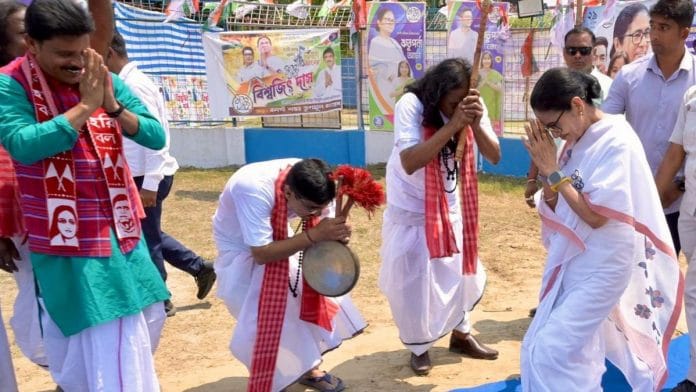
This was an innovation unprecedented in Bengal’s political history. The state was governed by the Congress during the first three decades after independence, barring a span of five years of political turmoil and President’s Rule between 1967 and 1972. Chief ministers during that era, such as Dr BC Roy, Prafulla Chandra Sen, and Siddhartha Shankar Ray, belonged to the same party that was in power in Delhi. It was when the Left Front assumed power in 1977 that the narrative of the central government’s “step-motherly treatment” of the state gained currency. Even then, the contest was between ideologies and policies, not one of regional identity. Not even when the National Democratic Alliance (NDA), led by Atal Bihari Vajpayee, came to power in 1998.
The new turn took place as recently as in 2021 when Banerjee faced a tough contest for her third term.
The TMC had come to power in Bengal in 2011, ending the three-and-a-half-decade rule of the Left Front. The contest remained bipolar until the assembly elections of 2016. The TMC’s main slogan was (mother, motherland, and people), coined by Banerjee around the 2009 general elections. The issue of Bengali political identity was still nowhere on the political horizon.
The contest remained bipolar but the challenger changed in the 2019 general elections. The Left Front and the Congress almost evaporated from the electoral calculus, being replaced by the BJP. The Modi wave of 2014 raised the party’s vote share from a mere 4 per cent in 2011 to 17 per cent, before it declined in 2016 to about 10 per cent.
In 2019, however, the BJP’s vote share jumped to nearly 41 per cent (against TMC’s 44 per cent), primarily on the back of a massive transfer of votes from former Left supporters. Banerjee now had a new opponent, an all-India party with a formidable election machinery.
Banerjee’s initial strategy against the rising popularity of the BJP led by Modi was to continue with the traditional vocabulary used by Left leaders when the party was a marginal factor in the state. Famously a ‘party of barbarians’ by former chief minister Jyoti Basu, the BJP was denounced by the Left as a communal party. However, for Banerjee, the fact that her party had been in alliance with the BJP-led NDA and had contested the 2006 state election together was a confounding factor. Yet, the two continued to attack each other on communal grounds. While the BJP accused Banerjee of pandering to the interests of the Muslims of the state, she hit back with her irate to chants of Jai Shri Ram, accusing the BJP of trying to destroy Bengal’s multicultural fabric.
It was probably the realisation that the communal plank alone was not enough to counter the BJP that led to adding a new dimension to the TMC’s image. Of course, the image of being the party that would defend the interests of Bengalis and protect Bengal’s legacy was the metanarrative, supported by a slew of measures directed at reaching out to the common voter. Only Bengal’s own daughter was concerned with the well-being of the average Bengali, and hence she was implementing schemes such as Didi ke Bolo (tell didi), Duare Sarkar (government at the doorstep), Sabuj Saathi, Swasthya Saathi, and grants for housewives and elders. Behind this directional change were the cold calculations of Banerjee’s election strategy advisor Prashant Kishore, who is from Bihar.
What came to Banerjee’s aid was the organisational weakness of the BJP, coupled with the lack of a credible face for the post of chief minister and a failure to devise a narrative tailored to appeal to Bengalis’ political and cultural sensibilities. A rush to induct ministers and leaders from the TMC just prior to the elections only bolstered the allegation that lacking an organic organisation, the BJP was hoping to thrive by poaching from the TMC.
The central leaders of the BJP, along with the prime minister and the home minister, were successfully projected as migratory birds who flew in only during the election season. They were , under whose vindictive leadership the central government was depriving Bengal of its legitimate rights under the federal structure guaranteed by India’s Constitution. A message was clearly broadcast—one whose spine-chilling violent would be visible after the polls—that outsiders would come and go, but the TMC would stay. Hence, people were asked to choose carefully.
In the high-voltage, high-stakes election, the BJP performed impressively, winning seventy-seven seats, but failed to achieve the target of more than two hundred announced by Amit Shah. The TMC not only formed the government with a comfortable majority, but also increased its vote share by 5 per cent.
Despite charges of corruption, violence, and maladministration piling up, the weakness of the BJP in countering Banerjee’s narrative led to an even better performance by the TMC in the 2024 general elections. The BJP’s seat count declined to twelve from eighteen. Its vote share, however, improved marginally. In a subtle transition towards greater reliance on regional identity, and to steal the wind from the BJP’s Hindutva sail, Banerjee softened her attitude toward the use of Jai Shri Ram as a slogan and invested in the construction of grand temples in the state.
In 2026, as in the previous two elections, Banerjee faces the triple challenge of anti-incumbency, polarisation of votes, and Modi’s personal popularity, but to a much greater degree. To add to her woes, the Left Front and Congress will be contesting separately, and a former leader of the TMC, Humayun Kabir, has formed a new party, which has with AIMIM, claiming to represent the interests of the state’s Muslims. These developments are expected to cut into her share of votes.
In addition, the effects of the special intensive revision (SIR) of electoral rolls, intervention by the Election Commission of India in reshuffling the state bureaucracy, and deployment of security forces on an unprecedented scale, supported by a vigilant judiciary, are yet unclear. Even the extent of communal polarisation among voters as an effect of incidents in the recent past, coupled with some of Banerjee’s statements, is an uncertain factor.
In this scenario of seemingly overarching negatives stacked against her, one big factor that still works in Banerjee’s favour is the organisational weakness of the Bengal BJP and its lack of a metanarrative grounded in Bengal’s realities.
As recent history has repeatedly demonstrated, it would be folly to underestimate Banerjee even when everything appears to be going against her. If she manages to pull out another victory despite the odds, not only will the politics around Bengali identity get shriller, but the BJP in Bengal might be staring at an existential problem. In the event of the BJP’s victory, if it is not a thumping one, the party will have a Herculean task to cover lost ground and ensure the sustenance of the victory.
(Edited by Asavari Singh)

