



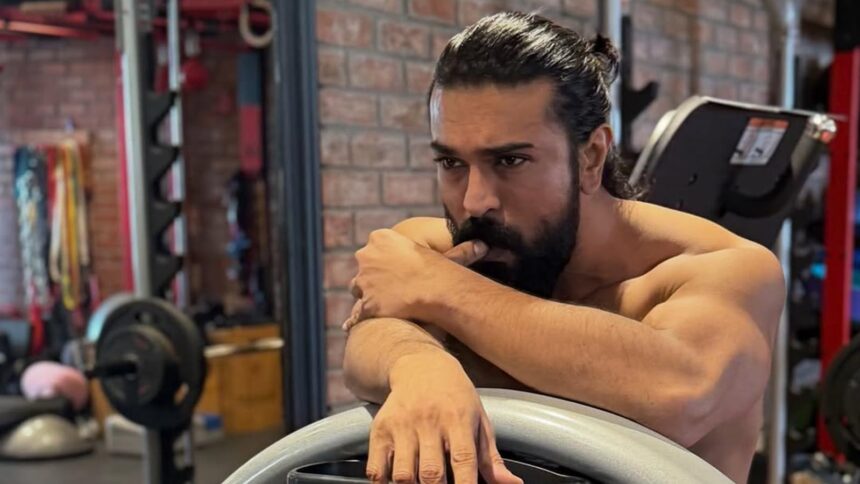
Actor Ram Charan’s physical transformation for his upcoming film Peddi wasn’t about chasing a sculpted, “Greek god” look. It was about building a body rooted in strength, function, and realism. According to his trainer, Rakkesh R. Uddiyar, the goal was to reflect the character’s journey authentically, with three distinct transformations planned across the film. “There will be three transformations of Ram Charan in the film,” he told SCREEN, adding, “The third will be a surprise for fans.”
Sharing the brief he received, Uddiyar explained, “Buchi Babu and Charan were very clear to me about the lead character in Peddi. He should look like a desi pehalwan. He should not look like a Greek god.” To achieve this, the training programme combined traditional akhada-style workouts with . “Monday, Wednesday, Friday, we did weight training with fasting cardio. Tuesday, Thursday, Saturday, we did functional movement with kushti exercises and mobility exercises.” The routine also included tools such as the gada, Surya Namaskar, rope pulling, and other functional drills.
Diet and recovery were just as structured. “We followed a structured 1,800-2,500-calorie plan, known as carb cycling. Some days low, some days high.” The process involved phases of calorie deficit to achieve a leaner look, as well as adjustments based on how the body responded. At one point, during a religious fasting period, maintaining performance became especially challenging. “That time was very difficult for us. He was already following a 50 to 60 per cent vegetarian diet. But putting him on a full vegetarian diet during training, it was difficult,” Uddiyar said.
The journey wasn’t without fluctuations. “There were ups and downs. Some days, I could see he was feeling low, and on those days, I’d give him extra calories. I could compromise there. But when it came to training, Ram Charan was exceptional.” The discipline extended to daily habits as well. “He (Ram Charan) would call saying, ‘I’m on the treadmill. Just come. I will get ready.’” Uddiyar also noted the challenge of mastering physically demanding movements: “He is not an athlete. He’s an actor. An athlete puts his entire body in motion. To catch that character and perform, it’s very tough. But every move he did, we were shocked at how he was doing it.” Reflecting on their working relationship, he added, “How Salman Khan is for me in Bollywood, Ram Charan is for me here in South cinema.”
The transformation, which has taken over sixteen months, highlights how fitness goals can vary depending on purpose.
Sadhna Singh, Senior Fitness and Lifestyle Consultant at HereNow Official, tells indianexpress.com, “A functional training approach prioritises strength, endurance, mobility, and real-world movement patterns, similar to how traditional wrestlers or labour-intensive workers build their physique through compound, high-effort activities. The focus is on performance, resilience, and the ability to sustain physical output over time.”
In contrast, she adds that an aesthetic, is typically shaped with an emphasis on muscle size, symmetry, and visual definition, often through isolated movements and controlled training splits. While both can be effective, functional training tends to produce a more adaptable and injury-resistant body.
Incorporating traditional training methods requires a gradual and structured approach. Singh mentions, “Bodyweight drills such as push-ups, squats, and animal movements can be integrated as part of warm-ups or conditioning sessions. Mobility work should be a consistent component to improve joint health and prevent injury, especially when combined with strength training.”
It is important to focus on technique, avoid excessive volume early on, and allow adequate recovery. Blending these methods with modern resistance training creates a balanced routine that supports both strength and functional capacity.
When adopting structured diets, Singh says, the key is to avoid aggressive restriction and ensure nutrient density remains high. Even in a calorie deficit, is essential to preserve muscle mass, while carbohydrates should be timed around training sessions to support performance and recovery.
“Monitoring energy levels, sleep quality, and workout output can help identify if the body is under-fuelled. A well-planned approach that includes periodic adjustments and sufficient micronutrient intake helps maintain both metabolic health and training efficiency,” concludes Singh.
DISCLAIMER:

